Node.js Security Update: Mitigations While Teams Upgrade to Fixed Releases
- Bhagyashree Thorat
- 587 reads
Node.js fixes a Brotli flaw in 22.23.4, 24.22.1 and 26.12.1. Inventory, interim controls and service restarts help reduce exposure while upgrades roll out.
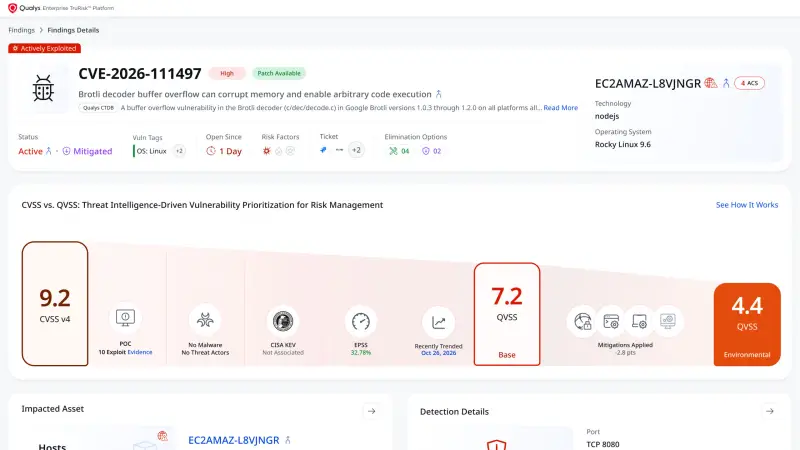
Node.js teams face a familiar but difficult security gap: a fix is available, but it takes time to reach every runtime. The October 21 security release addresses 10 vulnerabilities, including CVE-2026-111497, a Brotli decoder flaw that can allow remote code execution. Three other high severity issues affect DNS and TLS hostname validation. Qualys telemetry counted about 42,000 patched installations among roughly 3.3 million, while 1.7 million installations run unsupported versions that will not receive fixes.
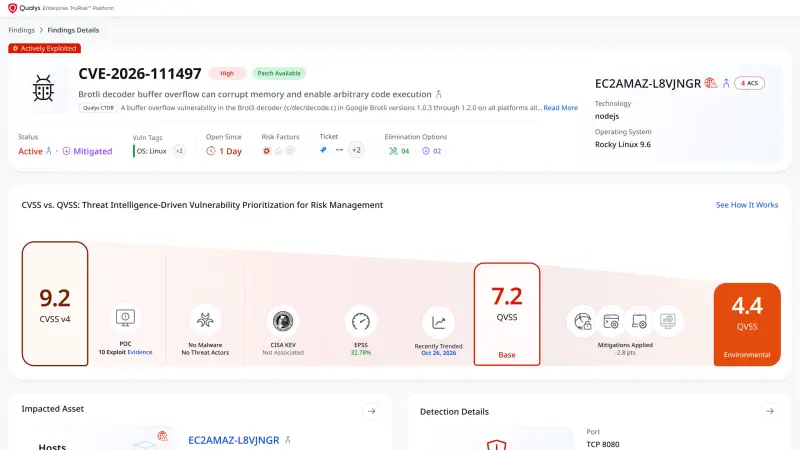
That gap matters because Node.js can be embedded in container images, single executable applications, serverless functions, version managers and application directories. Dependency scanners may miss runtimes in those locations. The practical response is to find every copy, rank the systems by exposure, apply temporary controls where upgrades are pending, then patch and verify each running service.
Start with the runtimes most exposed
Inventory should cover hosts, containers and cloud workloads, including bundled copies outside standard installation paths. Qualys customers can search for systems affected by CVE-2026-111497 and the other October 2026 Node.js vulnerabilities. The broader lesson applies to any fleet: a dependency list alone may not reveal which runtime a deployed process actually uses.
Prioritize internet facing services that decompress untrusted Brotli data. They present the most direct route to the remote code execution flaw. Next, look at services that connect over TLS to hostnames supplied by users, which are relevant to CVE-2026-106069 and CVE-2026-105483. Business criticality should also shape the order of work. Unsupported lines—including 25.x, 23.x, 21.x and 20.x—need migration to a supported release because no fix is planned for them.
Reduce exposure while upgrades are pending
Node.js has no official workaround for these issues. Interim measures identified by the Qualys Threat Research Unit can narrow specific attack paths, but they do not eliminate exploitation risk. Test application behavior after each change; input handling and connection settings can affect legitimate traffic too.
- Limit untrusted Brotli input. Avoid decompressing Brotli data from untrusted sources where possible. At a reverse proxy or WAF, cap payload size and the decompression ratio.
- Choose safer DNS handling. For user supplied names, use
dns.lookupinstead ofdns.resolve*, and reject hostnames containing NUL characters. This addresses the path associated with CVE-2026-105482. - Normalize IP addresses before TLS. Convert addresses to canonical form before passing them to a TLS connection, and reject fullwidth or other noncanonical forms. This applies to CVE-2026-106069, CVE-2026-105483 and CVE-2026-106072.
- Disable keep alive for untrusted servers. Turn off
keepAliveonhttp.Agentwhen connecting to servers the application team does not control. This limits the issue tied to CVE-2026-105481. - Don’t treat the Permission Model as a security boundary. On affected versions, it should be considered advisory in light of CVE-2026-106071 and CVE-2026-106073.
Use existing security layers
WAF and IPS protections can block exploit requests at the edge or in the network before they reach the Node.js decoder. Cloudflare, Fortinet and Check Point have published protections that identify the Brotli flaw. Qualys recommends setting the applicable Cloudflare rule to Block.
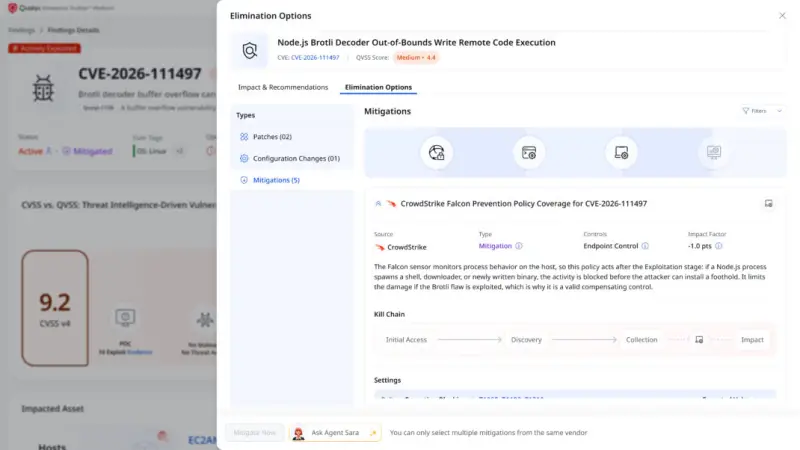
EDR tools provide another layer after a request reaches a host. Behavioral and exploit prevention features in CrowdStrike Falcon, Microsoft Defender for Endpoint and Cortex XDR may detect what follows an exploit attempt, such as a Node.js process launching a shell or downloading a binary. Some policies also respond to memory exploitation behavior. These controls vary by product and configuration; confirm that each policy applies to the relevant Node.js process and fires as expected. Rule and policy identifiers can change, so check them in the vendor console.
Network and endpoint controls change the risk picture, but they don’t replace a runtime update. Qualys says its ETM service is being extended to show applicable third party controls for findings, reflect deployed controls in the finding’s Environmental score, and let teams apply some mitigations through TruRisk Eliminate. Those capabilities are in development and subject to change.
Patch the runtime and validate the deployment
Fixed releases are available in Node.js 22.23.4, 24.22.1 and 26.12.1. Qualys reports a high patch reliability rating for these updates and says they do not require an operating system reboot. The end of life lines must move to a supported release. Qualys customers can check the patch catalog for updates through TruRisk Eliminate.
Installing a package doesn’t prove that the vulnerable runtime has left production. Upgrade every copy, rebuild container images and single executable applications using the fixed version, and redeploy them. Restart all Node.js services: long running processes can keep the old runtime loaded in memory after files have changed. Then rescan with Cloud Agent or Container Security and confirm the relevant detection QIDs have closed.
The useful measure of progress is coverage across deployed runtimes, including those hidden inside packaged applications. Temporary controls buy time and help teams prioritize; the upgrade, followed by a restart and a clean rescan, is what closes the exposure.


