PHP2Shell: Mitigate Exposure While PHP Patches Roll Out
- Bhagyashree Thorat
- 929 reads
Use configuration changes, reachability checks and existing security tools to reduce PHP2Shell exposure while teams patch affected systems.
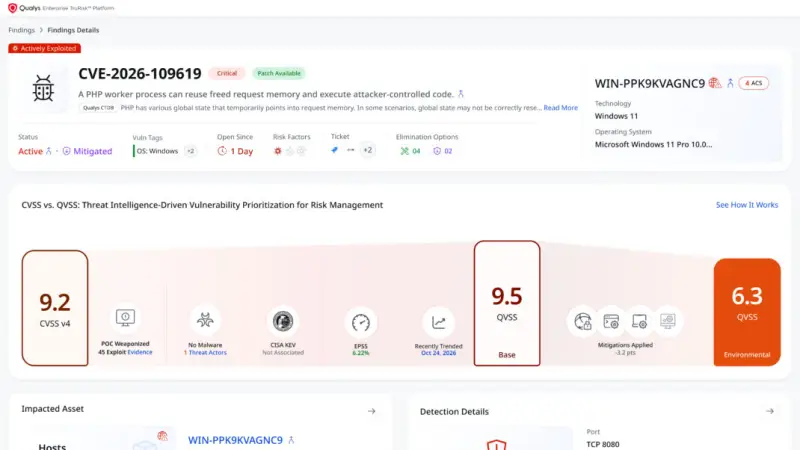
PHP2Shell creates a familiar gap between finding a vulnerability and updating every affected system. In the first 12 hours after disclosure, just 199,000 of 156 million PHP installations with known versions had been patched, according to Qualys telemetry. A configuration change and existing security controls can reduce exposure during that lag, but updating PHP remains the complete fix.
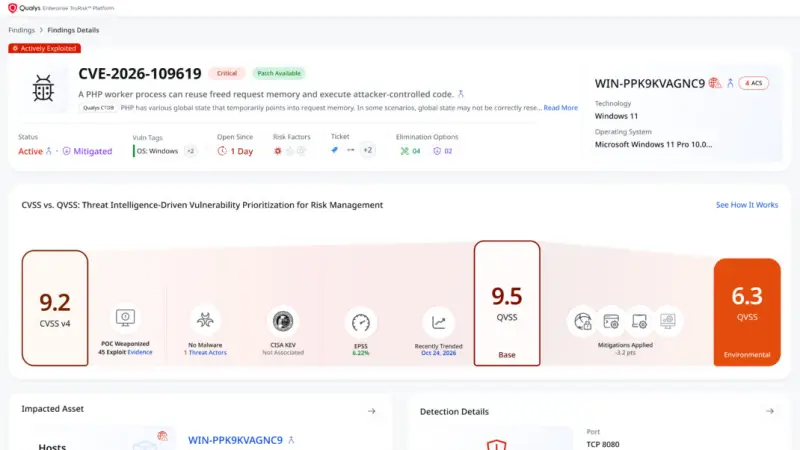
The practical response is to identify PHP systems, determine which are reachable through the confirmed attack path, apply a temporary mitigation, and add protections at the network and host levels. Each step helps prioritize work; none removes the need to patch.
Prioritize systems by exposure
PHP can be discovered through network scans, Cloud Agents, container assessments and Deep Scan where supported. Qualys TotalAppSec can also assess exposed web applications and APIs. Qualys recommends QID 45110 for PHP discovery, followed by the relevant vulnerability detection and software inventory QIDs to identify affected assets.
Finding a vulnerable version does not, by itself, show how exposed a host is. TruConfirm checks whether the tested PHP2Shell entry point is reachable and whether the upload-progress mitigation is absent. Its benign probe does not create files, execute code or apply memory pressure.
In one customer environment, TruConfirm returned positive results for 25 of 1,539 PHP assets. That can help teams rank systems alongside their internet exposure and business importance. A negative result is not proof that every route to exploitation is closed, so it should inform prioritization rather than settle the question.
Apply the configuration mitigation
Qualys’s mitigation follows PHP guidance and research by the company’s Threat Research Unit. It disables session upload progress and hardens related session handling, reducing exposure to the confirmed session-lifecycle attack path without changes to application code.
The mitigation is available for agent-managed systems through the Qualys dashboard. For appliances, DMZ servers and legacy hosts that cannot run a Cloud Agent, a script in the Custom Assessment and Remediation library within TruRisk Eliminate can run on scanner-based hosts.
Applying the change restarts the PHP service automatically. Teams should review the execution logs, restart manually if needed, and confirm that all PHP workers have loaded the updated configuration. Qualys checks the effective setting after restart, including whether another configuration overrides it.
There is a compatibility tradeoff: applications that depend on upload-progress functionality may behave differently. Test those applications after applying the change. The mitigation also does not cover every exploitation path associated with CVE-2026-109618 and CVE-2026-109619.
Use network and endpoint controls as extra layers
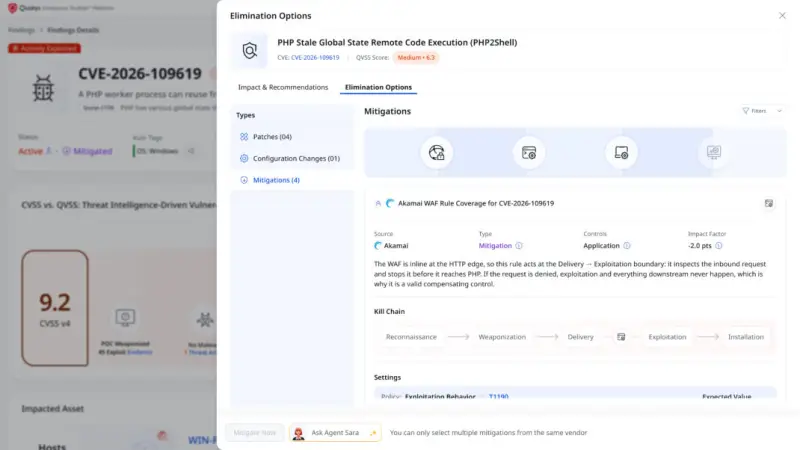
WAF and IPS signatures from vendors including Akamai, Cloudflare, F5, Palo Alto Networks, Fortinet and Check Point can block exploit requests before they reach PHP. Cloudflare has reported attack traffic with evasion attempts, a reason to treat signatures as one layer rather than a complete defense.
Endpoint detection tools can help contain what happens after an exploit succeeds. Behavioral policies in CrowdStrike Falcon, Microsoft Defender for Endpoint and Cortex XDR can watch for actions such as a web server process launching a shell or writing a web shell. These policies target follow-on behavior, so teams should verify that each one applies to the PHP worker and triggers as intended.
Vendor rule and policy identifiers were published in October 2026 and should be checked in the relevant consoles. Together, edge filtering, network inspection, configuration hardening and endpoint monitoring can narrow exposure while updates are prepared.
Patch, restart and check the running build
Qualys says supported PHP patches can be deployed through TruRisk Eliminate, rates patch reliability as High, and reports that this package update does not require an operating system reboot. After installation, teams still need to restart every service that loads PHP and confirm the running workers use the patched build. An installed package alone does not establish that active processes have stopped using the vulnerable version.
Repeat TruConfirm validation after patching, and verify the effective configuration after applying the temporary mitigation. These checks help catch systems where a service restart or configuration change did not take effect.
Risk scoring changes are planned
Qualys is developing changes to ETM, and the capabilities may change before release. The plan is to recommend applicable third-party controls for each finding, reflect installed controls in the finding’s QVSS score through an Environmental score, and enable teams to apply third-party mitigations through TruRisk Eliminate.
The goal is to distinguish two systems with the same unpatched PHP build when one is behind relevant WAF and endpoint controls and the other is directly exposed. For now, teams can use reachability results and their existing controls to guide priority. The work is complete only when every affected system has been patched, restarted and checked.


