Java4Shell: OpenJDK Base64 Flaw Puts Identity and Build Systems at Risk
- Saeed Abbasi
- 611 reads
Java4Shell affects unpatched OpenJDK on specific x86-64 CPUs. Patch exposed services and restart Java processes; a JVM flag can reduce risk while updates are tested.
Java4Shell turns a small Base64 decoding bug in OpenJDK into a broad infrastructure risk. On affected processors, malformed input can corrupt Java heap memory, potentially exposing secrets or enabling remote code execution. The vulnerable code lives in the runtime, so an application can be at risk even when its own code and libraries are current.
For teams responding to the issue, two details shape the work: the flaw requires a particular combination of Java version and CPU features, and the fix only takes effect after the Java process restarts. Start by identifying internet-facing identity, build, artifact, and collaboration services, then check the runtime each application actually uses.
What the flaw does
The bug is in handwritten assembly that accelerates Base64 decoding with AVX-512 instructions. A short malformed input can make the decoder write 62 bytes beyond a buffer before Java rejects that input. Because Base64 often carries login headers, tokens, and uploads, an application may reach the vulnerable code while handling a request from an unauthenticated user.
Researchers at Calif demonstrated pre-authentication remote code execution in default configurations of Keycloak, Atlassian Jira, Atlassian Confluence, JFrog Artifactory, Jenkins, and PingFederate. They also demonstrated exploits requiring an authenticated account against Apache Kafka Broker, Apache Solr, Elasticsearch, Gerrit, and Netflix Spinnaker. The researchers say those examples aren't a complete list; they also reached code execution in sample applications built with Apache Struts and Spring Boot.
The practical concern extends beyond the first compromised service. Identity systems issue credentials and tokens trusted by other applications. Build and artifact systems handle software that may later be distributed across an organization. A breach of either can expose downstream systems that trust its identities or artifacts.
Memory exposure and service availability matter too. An exploit chain may read Java heap contents before running attacker code, and heaps can contain tokens, private keys, or personal data. Crafted input can also crash the JVM. Java clients may be exposed: Calif reports that a Java program can be compromised by connecting over TLS to a malicious server.
Which runtimes and processors are in scope
Java4Shell affects unpatched OpenJDK-based builds from 17.0.6 onward, including versions 21, 25, and 27, when run on x86-64 processors with AVX-512 VBMI. The reported processor families include Intel Xeon from Ice Lake through Granite Rapids, and AMD EPYC and Ryzen from Zen 4 onward. ARM64 systems and x86-64 processors without the required feature are outside the described hardware scope.
The runtime range includes Oracle Java SE, Oracle OpenJDK, Oracle GraalVM for JDK, Eclipse Temurin, Amazon Corretto, Microsoft Build of OpenJDK, Azul Zulu, BellSoft Liberica, SAP SapMachine, and Red Hat OpenJDK. Oracle Java SE 8 Enterprise Performance Pack build 8u511b33-perf is also affected; standard OpenJDK 8 and 11 releases are listed as unaffected, as are releases before OpenJDK 17.0.6 and builds that already contain the fix.
Both conditions matter for exposure: the runtime must be vulnerable and the application must pass attacker-controlled data to the affected decoder. A CPU check can help teams rank systems, but it shouldn't be used to close findings. Workloads can move to newer hardware after a resize or migration.
On Linux, this command prints any of the four processor flags to check. The host meets the stated hardware condition only when all four are present:
grep -m1 '^flags' /proc/cpuinfo | tr ' ' '\n' | grep -E '^(avx512f|avx512bw|avx512vbmi|bmi2)$'Inventory the JDK each application actually runs. Containers, appliances, and commercial products may include their own runtime, which an operating system update or ordinary software inventory can miss.
Exploit readiness and immediate priorities
As of November 17, 2026, there was no public confirmation of exploitation in the wild. That is a weak reason to wait: the trigger is short, the root cause and technique are public, and Calif says details leaked before the fix. The researchers are holding back product-specific exploits for now, with plans to publish them later.
Calif says it found the bug with AI assistance in about an hour and produced an initial working exploit two hours later, at a reported AI token cost below $200. That account suggests the underlying research may be repeatable. There is no single exploit that works across every product, however: each requires its own chain, and network conditions affect the technique. That may slow broad attacks while leaving specific, exposed targets at risk.
Prioritize internet-facing identity providers first, followed by Jira, Confluence, Jenkins, and Artifactory. Then review other public Java services that process logins, tokens, or uploads, and assess internal Kafka, Solr, Elasticsearch, Gerrit, and Spinnaker systems. Give each system awaiting a vendor update an owner and a remediation deadline.
Patch, or disable the accelerated decoder temporarily
Updating the runtime is the complete fix. Oracle published fixed builds on November 17, 2026: Java SE 8 Enterprise Performance Pack 8u513-perf, Java 17 version 17.0.21.1, Java 21 version 21.0.13.1, Java 25 version 25.0.5.1, and Java 27 version 27.0.1.1. Amazon had also released Corretto 17.0.21.1.2 by November 17. Other OpenJDK vendors publish on their own schedules, so check the relevant vendor advisory and confirm that its build addresses CVE-2026-114938.
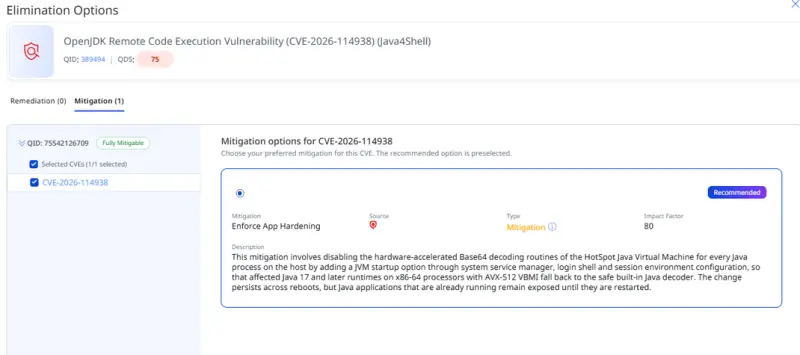
If a fixed build isn't available or can't be deployed immediately, a JVM startup option can disable the vulnerable decoder. The preferred option is -XX:-UseBASE64Intrinsics. It turns off the accelerated Base64 path and lets Java use its standard decoder. Applications doing substantial Base64 work may slow down, so assess that impact in your environment.
The alternative, -XX:UseAVX=2, disables a broader set of processor optimizations and can carry a wider performance cost. Use it only on Intel and AMD servers; Java on ARM won't accept the setting and won't start.
Either option requires a restart, as does a runtime update. Verify the running Java process after the restart rather than relying on an installed package record. A reverse proxy isn't a general safeguard: buffering requests may interrupt some exploit paths, but it doesn't remove the vulnerable decoder.
While waiting for an update, restrict access to exposed identity, build, and collaboration consoles, for example by placing them behind a VPN. Validating Base64 input and limiting input size can add defenses at the application boundary, but size limits alone won't stop this flaw because the malformed input can be very short. The JVM option directly disables the affected code path.
Finding and tracking affected systems
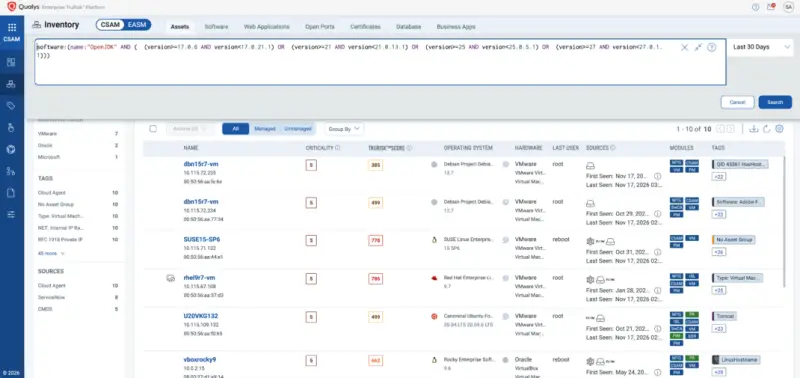
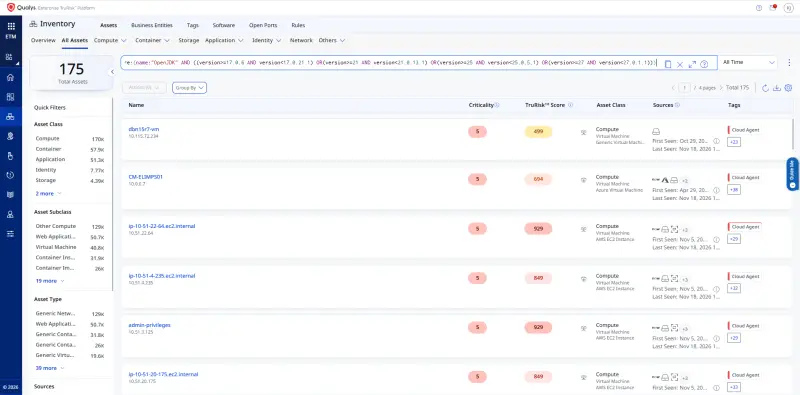
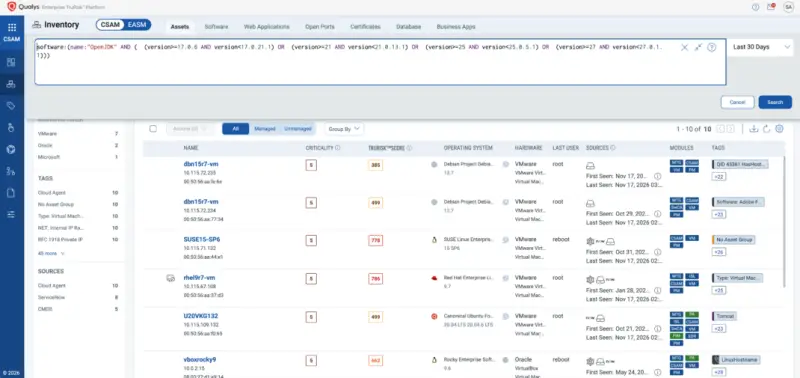
Asset inventories can identify Java installations and their versions, while application-level checks can help locate web services whose bundled runtimes aren't visible on the host. Qualys describes CSAM as a way to list assets with Java and inspect runtime vendors and versions. Its example query identifies potentially affected OpenJDK installations in versions 17, 21, 25, and 27 for further assessment:
software:(name:"OpenJDK" AND (
(version>=17.0.6 AND version<17.0.21.1) OR
(version>=21 AND version<21.0.13.1) OR
(version>=25 AND version<25.0.5.1) OR
(version>=27 AND version<27.0.1.1)
))
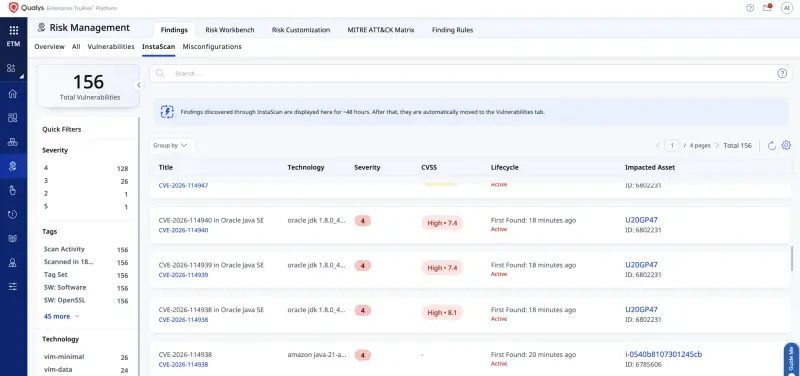
Qualys says InstaScan compares new vulnerability information with existing asset data collected through its agents, scanners, and imported tools. Findings appear in Enterprise TruRisk Management after the information is processed, without waiting for a new scan. They remain in the InstaScan view for about 48 hours before moving to the Vulnerabilities tab, where records from different detection sources can be combined. Teams can filter with finding.isInstaScan: TRUE or use the source badge to identify them.
Host-level detection has limits when a product bundles its own Java runtime. Qualys TotalAppSec provides an HTTP-level view intended to identify potentially affected web applications even when the underlying runtime isn't easy to find in host inventories. Its supporting checks include QID 150891 for Java web applications, QID 150896 for exposed Java class or JAR files, and QID 150898 for stack traces in HTTP responses. These checks can help locate applications and exposures; they don't by themselves confirm that a runtime is vulnerable.
Qualys lists QID 389494 for the OpenJDK vulnerability, QID 389610 for Oracle Java SE's November 2026 update, and QID 389608 for Amazon Corretto updates, all under release VULNSIGS-2.6.747-3. QID 533508 checks Jenkins, Jira, and Confluence versions by sending an HTTP GET request. The vendor says it plans to expand product coverage as more affected applications are identified.
Enterprise TruRisk Management can combine findings from Qualys and third-party sources and rank them using threat information, asset importance, and exposure. Qualys says its exploit-validation feature isn't available for Java4Shell because there is no public exploit. For now, prioritize by internet exposure and business criticality, then verify the processor condition as a way to order remediation.
Watch the runtime, not just the inventory
Look for unexpected JVM crashes or restarts on internet-facing services, Java processes that start shells or make unfamiliar outbound connections, and runtimes missing from the asset inventory. A mitigation can buy time, but the durable response is to apply a vendor-fixed runtime and restart every affected process. The key operational question is whether each application is now running the fixed code, including Java instances bundled inside containers and appliances.