AI Careers by 2031: Why More Opportunities May Be Outside the Tech Industry
- Pavel Yakovlev
- 587 reads
AI is changing software roles first, but robotics and slow to digitize industries could create the next wave of engineering work.
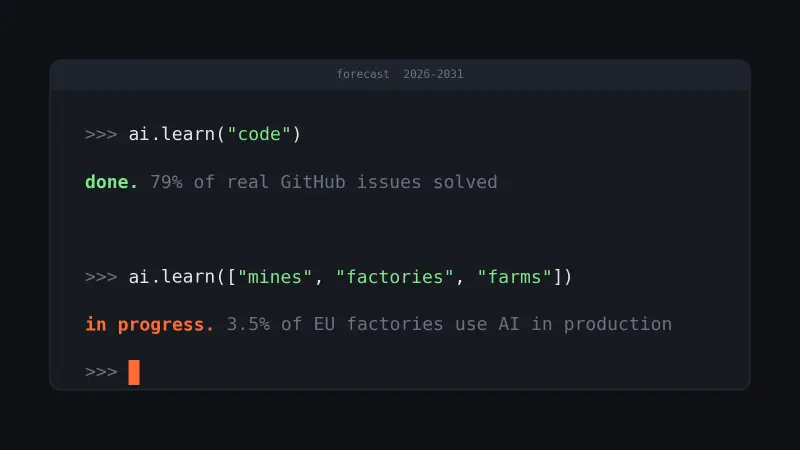
AI is changing what engineers do, but that doesn’t mean engineering work is disappearing. The likelier shift is from writing code by hand toward defining problems, directing AI systems and checking their output. By 2031, some of the most interesting machine learning roles may sit in mines, hospitals and factories rather than at software companies.
That’s the outlook behind five predictions for the next five years. The evidence is uneven: software hiring has fallen sharply, while AI adoption in many physical industries remains low. Some indicators point to real change; others are forecasts that will need to be checked against what actually happens.
Software is AI’s first proving ground
Software work has been especially exposed to AI because code is plentiful, structured and testable. GitHub has 225 million developers and 395 million public repositories. Code also made up about 17% of the 15.6 trillion tokens Meta used to pretrain Llama 3. That gives model builders a vast body of examples from which systems can learn common programming patterns.
Code also comes with unusually clear feedback. A compiler can reject invalid syntax, and tests can check whether a change produces expected results. DeepSeek-R1 used compilers and test cases to assess coding work, rather than relying on a learned reward model that could be gamed. Many fields have no comparable fast signal: it can take years to know whether a bridge design or diagnosis was right.
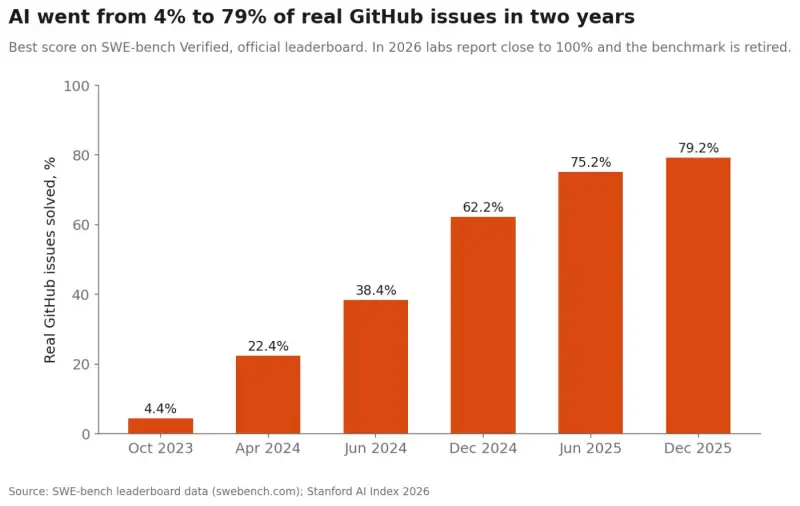
And code is a sequence of symbols, much like the text language models are built to predict. That fit has helped AI systems improve on software tasks quickly. On SWE-bench Verified, a benchmark made from real GitHub issues, leading systems went from solving 4% of tasks in late 2023 to 79% by the end of 2025. The Stanford AI Index reported scores near 100% a year later; OpenAI reportedly stopped using the benchmark, saying it had been contaminated.
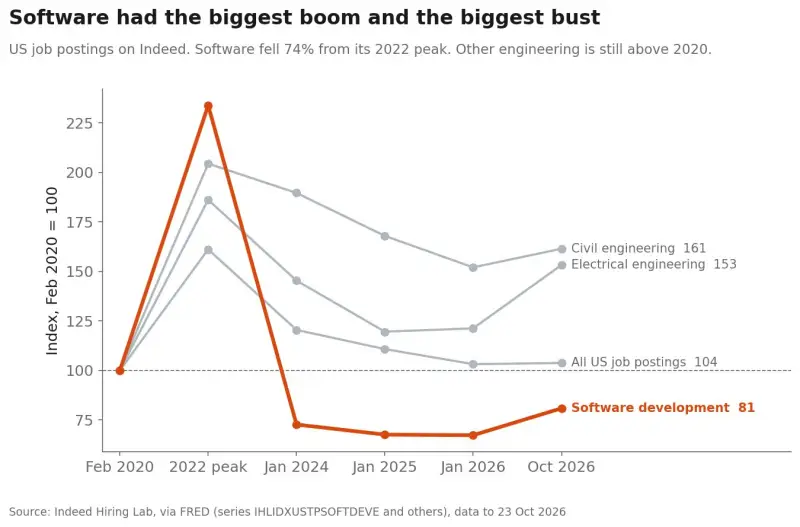
Hiring figures need more care. US software job postings on Indeed fell 74% between their 2022 peak and 2025 low, the steepest decline among tracked categories. But AI wasn’t responsible for the whole drop: Indeed’s analysis attributes nearly half to factors that preceded ChatGPT, including interest rates and over-hiring after the pandemic. Software postings have started to recover since early 2025, with 71% of that growth going to senior roles.
At AI companies, agents are already part of the development process. Anthropic said Claude wrote more than 80% of the code it merged in May 2026. Google said AI generated about 75% of its new code, which engineers then approved. More than 40% of GitHub pull requests now begin as an agent draft. Those figures describe companies building AI or using it at high intensity, though, not the typical engineering team: in Stack Overflow’s 2025 survey, 46% of developers said they distrust AI tools’ accuracy, while 33% said they trust it.
A randomized METR trial also found experienced open source developers were 19% slower with AI in early 2025. A later round indicated a possible speedup, but its error bars still included no effect. The practical result depends on the task, the tools and the time engineers spend reviewing output. The prediction is that by 2031 agents will write most code at most software companies, leaving developers to choose what to build and assess what agents produce.
Developers remain, but routine coding narrows
The claim that programmers will disappear by 2030 misses a distinction in job categories. The US Bureau of Labor Statistics projects software developer employment to grow 10% from 2025 to 2035, around three times the average for all jobs. That projection has fallen from 17.9% two years earlier. Meanwhile, the narrower category of computer programmers—workers who translate specifications into code—is projected to shrink 7%.
The mix of engineering specialties is shifting too. Frontend’s share of engineering hires fell about 25% since ChatGPT, the largest decline among specialties in SignalFire’s data. In early 2025, iOS and Android postings were down more than 60% compared with early 2020. Machine learning engineering is moving in the other direction: LinkedIn named AI engineer, also known as machine learning engineer, its fastest-growing US role for 2026.
Another emerging role is the Forward Deployed Engineer. These engineers work alongside customers to adapt AI systems to a company’s actual processes. US postings for the role rose from about 650 to around 5,300 in one year. The job points to a broader need: teams need people who can connect software, models and the messy details of how a business operates.
There’s less clear hiring data for QA, backend and DevOps. The forecast here is that routine quality assurance and a substantial share of standard backend work will contract, while engineers who run AI infrastructure will be in greater demand. Entry-level access is already a concern: in early 2026, only 4.5% of US software postings were for entry-level roles. Companies hiring seniors to supervise agents may create fewer junior positions where new engineers learn through routine work.
By 2031, the prediction is that the US will have more software developers than in 2025, but their work will look more like product engineering or customer-facing deployment. They’ll be expected to carry a problem from the user’s needs through production, while agents handle more of the typing.
Robotics faces a data bottleneck
Digital work is only half the picture. On a definition of artificial general intelligence based on ten areas of human cognition, GPT-4 scored 27% and GPT-5 scored 57%. METR, which measures how long models can complete tasks independently, found that this time horizon doubles every four to seven months. Yet long-term memory scored 0% in the cited assessment, and physical tasks remain largely untouched.
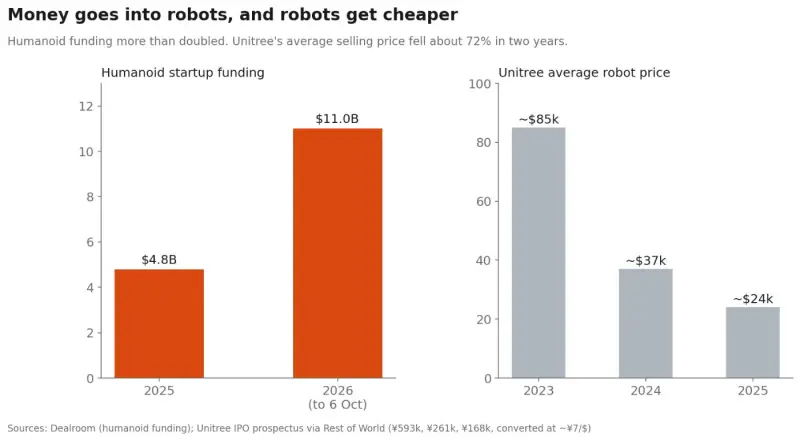
That gap is drawing investment and research toward robotics. Robotics startups raised $15 billion in 2025 and $18.8 billion by June 2026, according to Crunchbase. Funding for humanoid robots rose from $4.8 billion in 2025 to $11 billion in 2026, before that year had ended. NVIDIA CEO Jensen Huang called the moment “the ChatGPT moment for physical AI” in January 2026. Yann LeCun left Meta and raised $1 billion for AMI Labs to work on world models.
Robots have a harder learning problem than chatbots: they need data from interacting with the physical world. One of the largest open robot datasets, DROID, contains 350 hours of demonstrations. Labs are trying three approaches to fill the gap: simulated training, recordings of people doing everyday tasks, and machines learning from experience in real environments.
NVIDIA said its simulation pipeline generated 780,000 synthetic trajectories in 11 hours, equivalent to about 6,500 hours of human demonstrations. Figure’s Index app asks people to record household chores; the company says it has collected 16 million videos. Real-world deployment can provide data too, though it takes time and money. Waymo passed 500,000 driverless rides per week in April 2026, while Baidu’s Apollo Go had provided more than 22 million rides. Waymo’s effort took over fifteen years and still loses billions, illustrating the scale of the challenge.
Hardware costs are falling. Unitree’s average robot price dropped from about $85,000 in 2023 to about $24,000 in 2025, and its smallest humanoid starts at about $5,900. Hugging Face opened preorders in August for Microduck, a $399 open source walking robot trained with reinforcement learning in simulation. That October, Huang brought four Microducks to GTC Berlin. Lower prices make experimentation more accessible, though they don’t establish that robots can reliably perform useful work at scale.
The forecast is that by 2031 robots will handle paid physical tasks at scale in warehouses and factories, while robotaxis operate in most large US and Chinese cities. Home robots are expected to remain mostly hobbyist devices.
Physical industries are starting from a low base
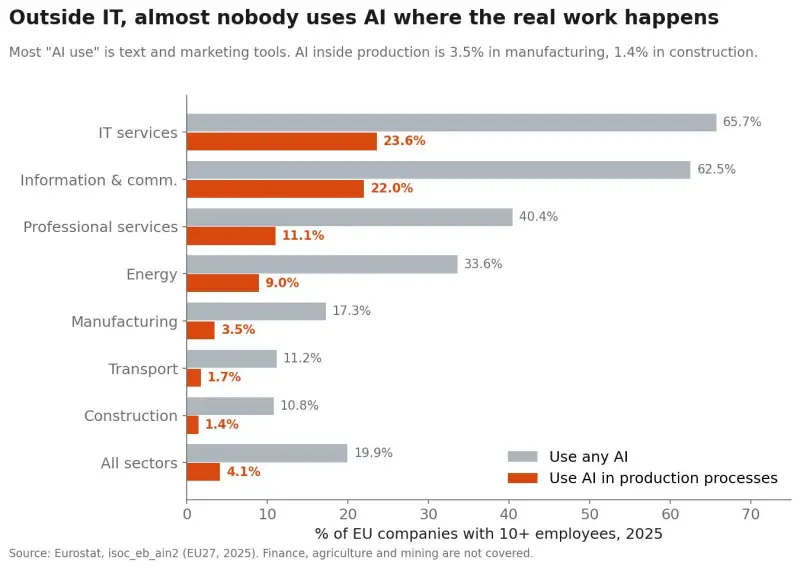
Some industrial uses are already established. At Newmont’s Boddington gold mine in Western Australia, driverless haul trucks had moved more than 100 million tonnes of material by 2022. But examples like this sit far ahead of typical adoption. About one in five businesses uses AI in the US and EU. Adoption reaches 35% to 60% in information and finance, compared with 7% to 15% in construction, transport, hospitality and mining. Even those broad figures can include basic uses such as drafting emails; AI embedded in production is rarer. In the EU, 3.5% of manufacturers and 1.4% of construction firms used AI in production.
Several barriers explain the gap. Many firms lack digitized operational data or use older equipment that can’t easily share it. Among EU businesses that considered but didn’t adopt AI, 44% cited data quality and 42% said the technology didn’t fit their existing systems. More than half pointed to unclear legal consequences or privacy rules. About two-thirds of EU companies had never considered AI, based on an estimate from Eurostat data. Among those that considered it and stopped, 70% cited a lack of expertise; only 18% said AI had no useful application.
Where adoption does happen, it often targets specific operational problems. There were 3,832 autonomous haul trucks working worldwide in July 2025, an 84% increase over the prior year. Shell has used predictive maintenance on more than 10,000 pieces of equipment since 2022, although only about 7% of US mining and oil companies use AI at all. Deere says its See & Spray computer vision system cut herbicide use by about half across five million acres.
Shipping offers a more incremental example: AI route and speed recommendations saved Stena Line 2% to 3% of fuel per trip. Fully crewless ships remain further off, with international rules for them due to become mandatory only in 2032. Medicine is further along than many people assume: around 1,500 AI medical devices have been cleared by the FDA, and one study reported that 7,260 doctors used AI scribes for 2.5 million patient visits.
The expectation is that attention and lower costs will bring more firms into the field. By 2031, the share of EU manufacturers using AI in production is forecast to rise from 3.5% to above 10%, while autonomous haul trucks could exceed 10,000 worldwide. Medicine, energy and manufacturing are expected to move first; construction and agriculture, last.
Where the next AI jobs may sit
AI skills are already requested outside traditional technology roles: half of job postings that ask for AI skills are outside IT, and those skills carry a 28% salary premium, according to Lightcast. Today, many AI engineers work for vendors that build systems for other companies. As more businesses bring AI into operations, the prediction is that mines, hospitals and manufacturers will hire engineers of their own.
The valuable combination is technical fluency plus knowledge of a specific operation. Engineers who understand transformers are increasingly common; those who can also interpret oil rig sensor data or work with hospital records are harder to find. The forecast puts the share of AI-skill postings outside IT above 65% by 2031, up from 51% in 2024.
For people choosing what to learn, the practical advice is to keep building fundamentals: Python, mathematics and classic machine learning. Then learn how to direct agents and verify their work. Understanding a real customer or operational problem will matter as much as knowing how to produce code. The next wave of opportunity may come from industries that have been slow to adopt AI, where the scarce skill is connecting models to work that happens in the physical world.