AI Oversight at Machine Speed: What Hiring Automation Reveals
- Christopher Martinez
- 642 reads
Hiring shows how automation can outpace human review. Better AI oversight starts by choosing where to speed up and where human judgment must remain.
Adding a person to an automated workflow doesn’t guarantee meaningful oversight. When AI agents and other automated tools increase the pace and volume of decisions, people may be left with too little time or context to intervene. The harder design problem is deciding which steps can run quickly and which need to slow down for human judgment, with clear limits that keep automated actions aligned with authorized intent.
Hiring offers a practical warning. Tools intended to manage application volume have helped create a feedback loop: applicants use generative AI to produce more tailored applications, while employers add automation to process the resulting flood. Each side’s response encourages the other to do more of the same. The result can be a hiring process in which machines produce, sort and assess applications while human recruiters have less opportunity to evaluate people directly.
How hiring automation feeds on itself
Recruitment technology predates generative AI. Employers have used automated filters, including keyword matching, to help sort resumes. But generative tools make it easier for applicants to produce polished, customized materials at scale. A survey of hiring managers found that applicants per hire tripled between 2021 and 2024, while Greenhouse reported a 412% increase in applicants per job posting. Job seekers are also using generative AI to adapt applications for large numbers of roles.
Employers have responded with more automated screening. Ninety-one percent of HR departments report using AI in recruitment. Greenhouse data also indicates that the number of human recruiters has fallen by more than half. At that scale, remaining recruiters may not have the time to review each application closely. Some employers have extended automation into interviews, so an applicant may reach late stages without speaking to a person at the company.
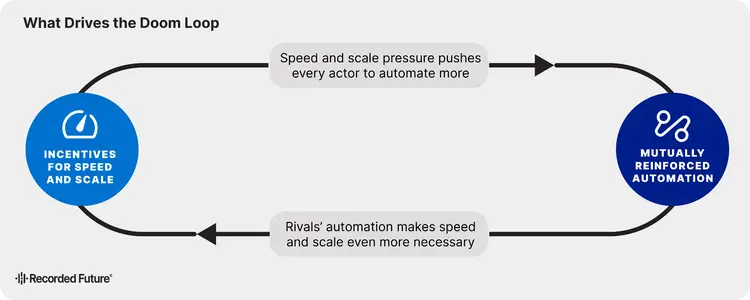
That chain of responses is what makes the “doom loop” label apt. As application volume grows, employers automate more of the process. Applicants then have more reason to optimize their materials for automated filters, which can increase volume further and make automated evaluation harder to trust. Greenhouse’s CEO has used the phrase to describe this cycle.
More automation hasn’t assured a faster process
The practical return is unclear. Only one-third of recruiters surveyed said AI had improved time-to-hire, while a quarter said hiring had become slower. Those figures complicate the case for expanding automation simply because application volume is high. If a system adds steps, produces more material to review, or makes it harder to identify suitable applicants, automation may shift work rather than reduce it.
There are also costs that don’t show up as processing time. Job seekers have described frustration with automated interviews and limited access to real people. Some employers have lengthened probation periods, suggesting that screening may not be giving them enough confidence in hiring decisions. Automated processes can also create opportunities for scammers and cybercriminals to pose as applicants, adding another reason to preserve checks that can assess context and identity.
These outcomes don’t mean every recruitment task needs a person at every step. They do show why oversight needs to be designed around the decision being made. Sorting information into a queue may tolerate a higher degree of automation than judging a person’s suitability or deciding whether to advance them. Where a decision has lasting consequences, reviewers need enough time, relevant information and authority to question a system’s recommendation.
Design for the incentives, not just the tool
Hiring is especially vulnerable to this pattern for two reasons. First, speed and scale are rewarded on both sides: applicants benefit from applying quickly to more roles, while employers face pressure to process large queues. Second, the automation reinforces itself. Employers automate to manage volume; applicants adapt to the filters; and employers then face a still larger stream of machine-shaped applications.
Those dynamics can appear in other workflows where people compete on speed and systems respond by processing more activity automatically. Teams should therefore assess the incentives surrounding a workflow, not only whether an AI tool can complete an individual task. A system that performs well in isolation may still amplify behavior that makes the whole process less useful.
For practitioners, that means defining what a successful outcome looks like before optimizing for throughput. It also means deciding where human review adds real value, setting boundaries on what agents can do, and checking whether changes in one step are pushing more volume or risk into another. A human reviewer who cannot inspect enough cases or override a recommendation is present in the process in name, but provides little practical control.
The central lesson is to manage speed deliberately. Let routine work move quickly when its risks and limits are understood; slow the process where context, accountability or consequential judgment matters. Hiring’s feedback loop shows that once automation and incentives begin reinforcing each other, inserting a person late in the workflow may not restore meaningful oversight. The next measure of progress should be whether automated systems support better decisions, not simply whether they handle more activity.
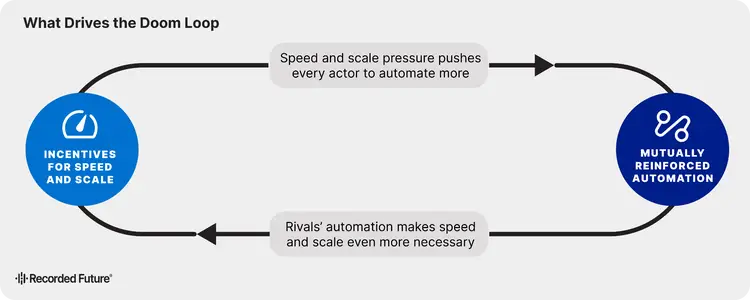
Figure 1: The cycle links incentives for speed and scale with mutually reinforcing automation.
===DONE