October 2026 Vulnerability Review: 82 High-Impact CVEs and PHP2Shell Activity
- Robert Jones
- 370 reads
October brought 82 high-impact vulnerabilities, including PHP2Shell flaws linked to root access and internal pivoting; 37 enabled remote code execution.
October’s vulnerability picture combined a modest drop in volume with a sharp operational focus: attackers were exploiting 82 high-impact flaws across 51 vendors, and activity around two PHP vulnerabilities showed how an initial foothold could lead to deeper access. Insikt Group classified 52 of the 82 as Very Critical by its Recorded Future Risk Score. The total was 13% lower than September’s 94.
Data came from three channels: 36 vulnerabilities appeared in CISA’s Known Exploited Vulnerabilities catalog, 33 were found in open sources and validated by Insikt Group, and 13 surfaced exclusively through honeypots. Citrix and Microsoft together accounted for about 15% of the month’s vulnerabilities. The affected products ranged from network edge and security management appliances to operating systems, endpoint software, collaboration and content platforms, and AI, developer, and automation tools.
Prioritization signals across the month
Remote code execution was possible in 37 of the 82 vulnerabilities. Collaboration, content management, and enterprise platforms formed the largest affected product category, with 12 vulnerabilities; Microsoft had the largest vendor share, with three. Insikt Group found public proof-of-concept exploits or scanners for 37 vulnerabilities, though the presence of a public demonstration does not establish that it works as described.
The most frequent weakness was CWE-78, OS command injection, with eight cases. Improper authentication (CWE-287) appeared in seven, while path traversal (CWE-22) and command injection (CWE-77) each appeared in six. Age also matters: 10 vulnerabilities were at least five years old, and the oldest was about 16 years old. Teams reviewing their backlogs should therefore treat this as a mix of new exposure and long-standing weaknesses that may persist in systems awaiting upgrades.
The month’s reference list covers 69 actively exploited or operationally weaponized vulnerabilities, excluding the 13 found only through honeypot data. It spans legacy software such as GNU Bash, ProFTPD, and Apache Struts as well as current enterprise and security products. Recorded Future assigned scores of 99 to 39 entries, with the rest scoring 89, 79, or 70.
Among the listed products are Ivanti Connect Secure, Fortinet FortiOS and FortiMail, Palo Alto Networks PAN-OS, Cisco Secure Firewall and Secure Email Gateway, Citrix NetScaler, GitLab, Microsoft SharePoint Server, WordPress, and Plex Media Server. Four separate Plex CVEs appeared in the table, each marked as included in the Known Exploited Vulnerabilities catalog. The list also flags whether a vulnerability is associated with remote code execution and links examples of public proof-of-concept material for some entries.
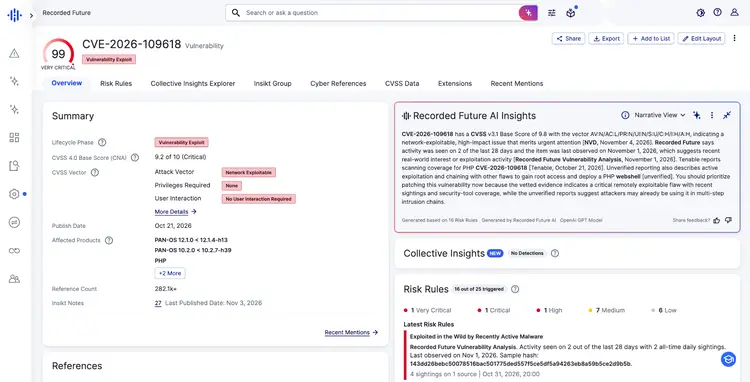
Those links are leads for investigation, not validation: the examples were not tested for accuracy or effectiveness. Security teams should confirm a proof of concept in a controlled environment before using it. Insikt Group also created Nuclei templates to detect PHP2Shell CVE-2026-109618 and CVE-2026-109619, as well as CVE-2026-87902 in WordPress and CVE-2026-86124 in AutoAgent. The templates are available to customers through the Recorded Future Intelligence Operations Platform.
PHP2Shell: initial access and privilege escalation
The clearest technical story involved CVE-2026-109618 and CVE-2026-109619, collectively called PHP2Shell, and CVE-2026-46300, a Linux kernel flaw known as Fragnesia. In one reported campaign, PHP2Shell provided initial access and Fragnesia enabled privilege escalation. Dream Research reported root access on 25 servers. On those systems, the actor deployed web shells, collected configurations, credentials, and private keys, and maintained reverse SSH tunnels to internal systems. The access enabled service-account password decryption and Active Directory enumeration; attempts to create domain accounts were not confirmed.
That sequence is the practical concern for defenders: a vulnerable web-facing PHP service can become a route into connected systems when a separate local weakness allows higher privileges. The campaign report describes a chain of techniques, not proof that every vulnerable PHP installation was compromised. Teams should check both internet-facing PHP deployments and the Linux systems behind them, then look for evidence of shell execution, unexpected tunnels, and access to stored secrets.
Technical analysis attributed PHP2Shell’s impact to memory-lifecycle failures that can enable unauthenticated remote code execution. Apache deployments using mod_php were highlighted as exposed configurations. Researchers also cautioned that early proof-of-concept code had not been validated. Separate reporting described staged exploits, checks for prerequisites, and a chain moving from a memory leak to command execution.
Botnets, staging activity, and detection
Reports during October described several kinds of activity around the PHP flaws, with different levels of confirmation. Potassium, a Mirai-derived botnet, was associated with probes and attempts to download payloads. Other observations included PHP2Shell testing, scanning, download attempts, and persistence behavior in Linux bot activity. Insikt Group also described an extortion actor’s staging server and a CYFIRMA assessment of suspected North Korean preparations involving 21 compromised nodes checking 216 hosts. CYFIRMA linked the activity to Lazarus Group with moderate confidence. These reports did not establish a successful PHP2Shell compromise in the cited preparations, nor did botnet observations confirm successful malware delivery through the flaws.
Detection guidance combines host and network signals. Insikt Group developed Sigma rules for Linux and Windows to identify web or PHP worker processes spawning shells, including PowerShell. Suricata and Snort rules target multipart requests involving session IDs and upload progress. Network inspection depends on visibility into HTTP request bodies, and a single alert may reflect benign behavior. Correlating alerts with process creation, worker errors, and outbound connections can help teams separate suspicious activity from routine application traffic.
A separate PHP issue to track
CVE-2026-115560 is a distinct PHP vulnerability, not part of PHP2Shell. It could allow unauthenticated remote code execution in applications that switch session serializers while upload progress is enabled. No exploitation in the wild had been established at the time of reporting. PHP recommended disabling session upload progress while a separate fix was pending; the initial PHP2Shell patches did not address this issue.
October’s figures are lower than September’s, but the mix of exploited legacy flaws, exposed enterprise products, and chained PHP and Linux vulnerabilities keeps remediation context-specific. Inventory exposed services, validate detections against host behavior, and track fixes for both PHP2Shell and the separate session-handling issue.