MongoDB Upgrade Roadmap Maps Version Hops, Checks and Rollback Limits
- Zelmar Michelini
- 670 reads
A browser based roadmap organizes MongoDB upgrade steps, compatibility checks and rollback limits across versions, cluster setups and related tools.
MongoDB upgrades are manageable when every version hop is planned. The hard part is coordinating the database binaries with feature compatibility, application drivers, package repositories, backups and monitoring. A missed prerequisite can leave a cluster partway through maintenance, with the available rollback options narrowed and the maintenance window slipping away.
The MongoDB Upgrade Roadmap gathers those requirements into a plan for a chosen starting version, target version and deployment setup. It covers Percona Server for MongoDB and MongoDB Community, with versions from 3.0 through 9.0, including releases 8.2 and 8.3. The tool runs as a static page in the browser; it doesn’t connect to the database or send the entered details elsewhere.
Why version hops need their own checks
MongoDB major releases require sequential upgrades. A cluster moving from 4.4 to 8.0 must pass through 5.0, 6.0 and 7.0. Each hop brings its own compatibility requirements, procedure and rollback conditions, so a plan for the final version alone leaves important steps unspecified.
Feature compatibility version, or FCV, is central to that sequence. The next upgrade depends on setting FCV at the right point in the current hop. The roadmap’s guidance is to do so after every cluster member runs the new binaries and the cluster has been checked. Until FCV is advanced, returning to the previous binaries remains possible; after the change, binary downgrade is no longer available.
Other dependencies can break independently of the database server. Major versions use separate package repositories, and a held or pinned package can keep a host on the old binaries even when the upgrade procedure has started. The shell and database tools may also need separate attention instead of following the server automatically.
Application compatibility deserves the same scrutiny. A driver that still uses legacy opcodes will stop working with MongoDB 6.0, and the failure may appear in application logs rather than in the database’s upgrade process. Backup and monitoring products also maintain their own supported version ranges. Percona Backup for MongoDB (PBM) and Percona Monitoring and Management (PMM) should be checked against the server version at each stage.
Security status can vary by product and release series. A target version may still have known vulnerabilities, and a fix available in MongoDB does not necessarily have a corresponding Percona Server for MongoDB build in every series. Those details make it useful to check each destination version rather than treating “upgrade complete” as proof that every concern is resolved.
What the roadmap puts in one place
For each hop, the roadmap groups the work into checks before the change, upgrade steps, checks afterward, rollback guidance and behavior changes. Preflight items include a command, where it should run—such as on the primary, each mongod or a mongos—and the expected result. Upgrade procedures account for topology and package manager, including apt and yum, as well as the Percona Operator for MongoDB on Kubernetes.
The plan can also account for driver, PBM, PMM and Operator versions, along with CPU and operating system details. That lets teams review compatibility across the whole deployment path instead of checking only the database server. Each item links to the relevant documentation section, and the roadmap flags places where documents conflict rather than concealing the disagreement.
Some procedures have been exercised on lab clusters, including replica set paths using apt or yum, patch upgrades and the Operator. The roadmap labels those items “Tested on a lab cluster.” That label is useful evidence about the procedure, but it doesn’t establish that a particular production setup will behave identically.
A 6.0 to 8.3 example
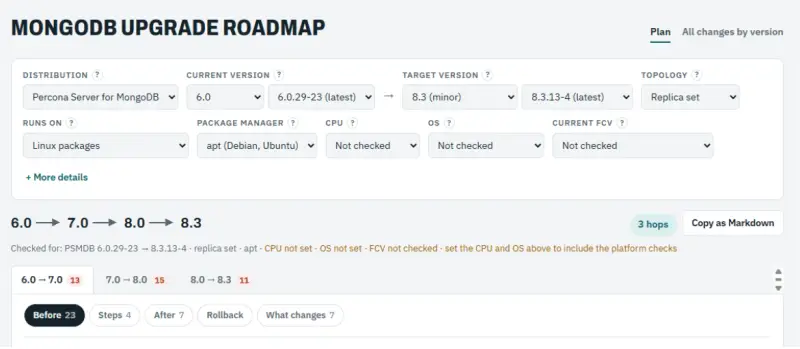
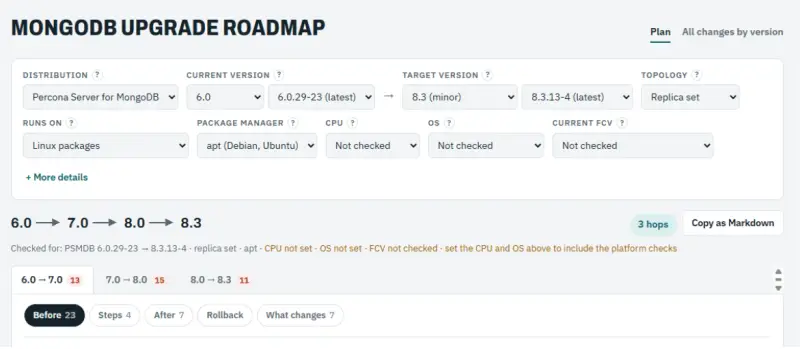
For a Percona Server for MongoDB 6.0.29-23 replica set using apt, with 8.3.13-4 as the destination, the roadmap lays out three hops: 6.0 to 7.0, 7.0 to 8.0, and 8.0 to 8.3. Each hop has its own tab and sections for work before, during and after the upgrade, plus rollback notes and behavior changes.
On the 6.0 to 7.0 step, the plan includes 23 preflight checks, four procedure steps and seven post-upgrade checks. Checkboxes help track progress, while “Copy as Markdown” formats the plan for a change ticket. That makes the roadmap useful as a working checklist, particularly when several people are responsible for different parts of the upgrade.
When a migration may fit better
An in-place upgrade isn’t the only route. Percona ClusterSync for MongoDB (PCSM) copies data to a new cluster running the target version and keeps it synchronized through change streams until applications switch over. Its compatibility matrix supports upgrades from 6.0 to 7.0 or 8.0, and from 7.0 to 8.0. That gives a 6.0 cluster a documented path to 8.0 in one step.
The migration approach has limits that affect fallback planning. PCSM doesn’t synchronize users or roles, doesn’t check FCV on the target and has no reverse synchronization path. Teams considering it need to account for those gaps and plan how application cutover and recovery will work.
Use the plan as a starting point
The roadmap is a documentation guide, not a substitute for testing. Run the intended sequence against a staging cluster that matches production in database versions, drivers and supporting tools. That is where teams can catch local configuration issues and confirm application behavior before committing to the maintenance window.
For a direct upgrade from 4.4 to 8.0, the supported sequence still passes through 5.0, 6.0 and 7.0, with FCV handled at each hop. The practical value of the roadmap is making those transitions and their dependencies visible together. Its plans and knowledge base are available at zelmario.github.io/mongodb-upgrade-roadmap, with the project on GitHub. As MongoDB versions and related tools change, keeping that compatibility map current will determine how useful it remains.