Galera Node Weights: When Quorum Flexibility Adds Operational Risk
- Marco Tusa
- 343 reads
Galera weights can break ties in even sized clusters, but they shift failure risks and add configuration work. Total voter weight matters more than node count.
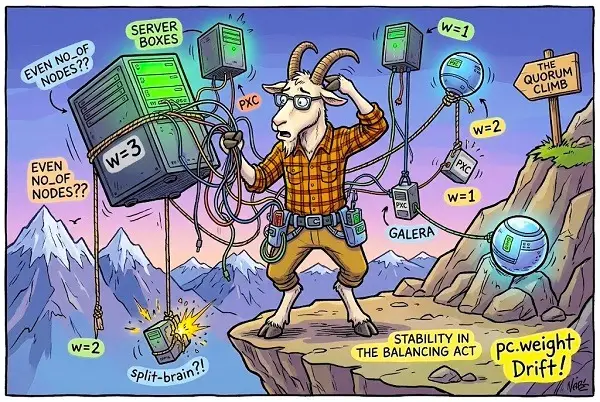
Galera lets operators assign different quorum weights to nodes, so an even sized Percona XtraDB Cluster (PXC) can have a preferred winner when the network divides. That flexibility comes with a tradeoff: weights move risk between failure scenarios and add operational work. They don’t provide a general increase in resilience.
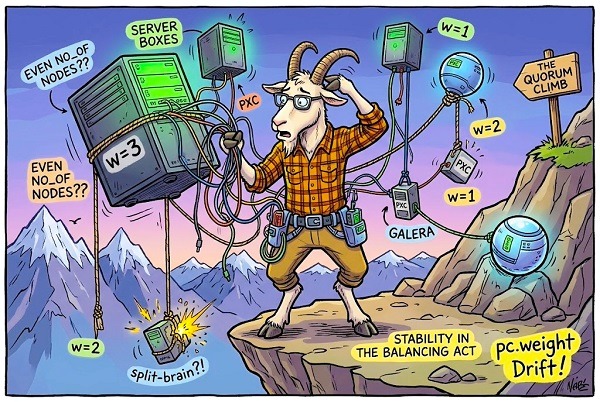
The familiar advice to deploy an odd number of Galera nodes is a shortcut for avoiding ties when nodes have equal weight. It isn’t a guarantee that the cluster will stay available after every failure. When Galera can’t establish a safe majority, it stops accepting transactions. That pause is preferable to letting disconnected groups write independently and then having to reconcile conflicting data.
Galera also offers pc.weight, set through wsrep_provider_options, to give nodes different influence in quorum calculations. The practical question is whether that setting can make an even sized cluster safer. It can make a chosen partition win, but choosing the weight distribution requires understanding how membership changes affect the calculation.
Quorum depends on the cluster’s current view
A Galera View is the membership list agreed upon by nodes that are communicating at a particular moment. A node joining, leaving cleanly, or dropping off the network can trigger the remaining members to form a new View with its own ID. The members then determine whether their group has enough of the previous Primary Component’s voting weight to continue processing transactions.
A group with sufficient quorum becomes the Primary Component. A disconnected group without quorum becomes non-primary and stops database operations. A View describes which nodes are together; quorum determines whether that group can safely keep running.
A sample log shows a Primary Component with three members and one partitioned node:
2026-11-10T13:45:01.498927Z 0 [Note] [MY-000000] [Galera] Node 49d8df08-bad6 state primary
2026-11-10T13:45:01.500967Z 0 [Note] [MY-000000] [Galera] Current view of cluster as seen by this node
view (view_id(PRIM,49d8df08-bad6,93)
memb {
49d8df08-bad6,2
5ce1a9aa-8e06,2
8458c8f0-9b8f,2
}
joined {}
left {}
partitioned {	85a6e937-b8c4,2}
)
The quorum check compares the weight of the last Primary Component with the weight in the candidate group. In the notation below, p is the membership of the last Primary Component, m is the evaluated group, l is the members that left cleanly, and w is each node’s configured weight, from 0 to 255:
Σ p·w < 2·(Σ m·w + Σ l·w)
A node that crashed or became unreachable still contributes to the previous Primary Component’s weight, raising the bar for the surviving group. A clean departure is credited to the new group instead. Nodes that were not in the previous Primary Component, including a newly joined or rejoined node, don’t count in this check. The implementation compares the weighted members and clean departures that overlap with the previous Primary Component against its total weight. See the Galera implementation and this background on quorum calculation in MySQL and Galera.
Even node counts are only part of the equation
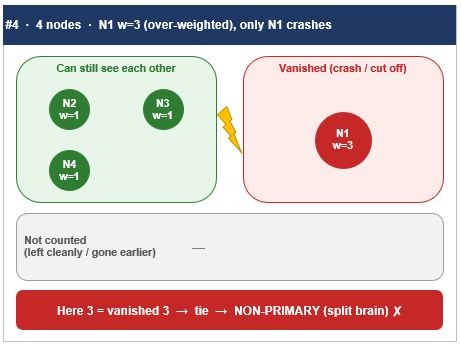
With four equal nodes, a two versus two network split creates a tie. Assigning one node extra weight can give one side a clear majority, but that choice can leave other failure combinations unable to reach quorum. A poorly balanced setup can make the loss of one node enough to stop the cluster.

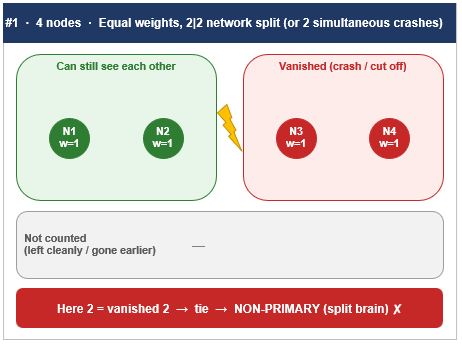
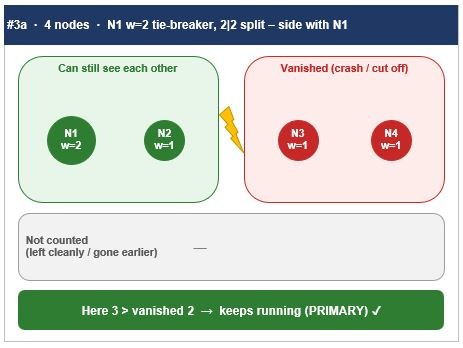
Failure order matters, too. If nodes fail one after another and the cluster has time to establish a new Primary Component between failures, the later quorum calculation uses that smaller membership. The same physical cluster can therefore behave differently depending on whether failures arrive together or in sequence.
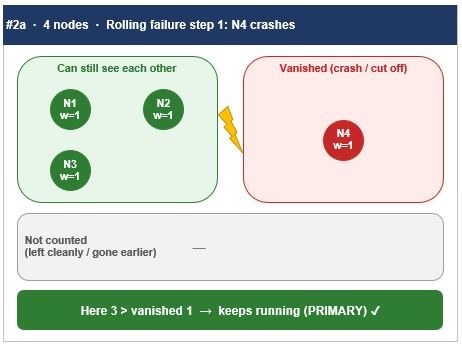
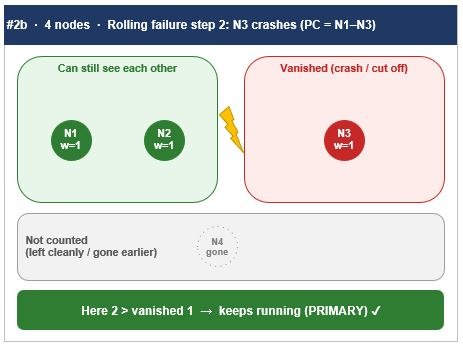
This is why node count alone gives an incomplete picture. What matters in a simple partition is the parity of the total weight being counted. An odd total cannot divide into equal halves; an even total can. Five equal nodes, each with weight 1, have a total weight of 5, so a two way split produces 3–2 or 4–1. Six nodes with one node weighted 2 also total 7. A Galera Arbitrator, or garbd, can provide another vote with the same effect.
By contrast, three nodes weighted 2, 1 and 1 total 4. That odd node count still permits a tie. Weight parity explains ties in a simple split, but it doesn’t guarantee that any group will hold quorum in more complicated conditions.
Where odd totals still lose quorum
Membership changes can turn an odd total into an even one. After one failure, a five node cluster has four members; a later 2–2 split can tie. A clean shutdown can also change the counted weight: if one of five equal nodes leaves gracefully, the remaining counted weight is four, allowing another tie.
Multiple network partitions create a different problem. In a 2–2–1 split of five equal nodes, no two groups tie, yet no group holds more weight than all the others combined. Every group can become non-primary.
Odd sizing also doesn’t grant unlimited failure tolerance. A five node cluster can survive two failures in the stated scenario, but not three; six nodes have the same stated limit. Geographic placement matters as well: in a two site 3–2 arrangement, the three node site can keep running through a link cut, but the two node site stops if the larger site goes down. Surviving the loss of either site calls for a third location, even if it runs only garbd.
For clusters that scale dynamically, including those managed by Kubernetes operators, planning for a particular size or weight balance is harder. The Primary Component can shrink, and each new membership changes the calculation. A broader set of quorum cases is available in this quorum calculation PDF.
Weights trade ties for a designated failure point
A node weighted 2 effectively represents two votes that always fail together. A four node setup weighted 2, 1, 1 and 1 has the voting total of five equal votes, but those first two votes sit on one machine. In a clean 2–2 split, the group with the heavier node gets a fixed advantage. The cost is that losing that node alongside another node can be fatal. At weight 3, losing the heavier node alone can create a tie.
The survivable failure set shifts rather than grows. Operators must track which node is special, reflect that in runbooks and monitoring, and account for it during maintenance. A clean shutdown of the heavy node changes how its weight is counted; if it crashes while another node is already unavailable, the cluster may stop. Moving the weight before patching or rebooting can be necessary, and a missed step creates risk.
Weights also need to stay consistent across configuration files, rebuilds and replacements. A rebuilt node that returns at the default weight of 1 silently changes quorum behavior. With two data centers, weighting one side makes it the designated winner during a split, but it doesn’t let the other side keep running if the favored site fails. The same limitation applies to a fixed three node versus two node layout.
Choose the simplest arrangement that meets the need
For a given goal, equal weight nodes are the easiest arrangement to operate. An even number of data nodes plus garbd keeps the data nodes equal and adds a tie breaking vote; placing the arbitrator at a third site can help the cluster survive the loss of either main site. Unequal weights are most defensible when another node or an arbitrator can’t be added and operators deliberately want one side to win a split.
The practical recommendation is to aim for an odd total weight in the active Primary Component and use a third location or arbitrator for multi site designs. That still can’t prevent a cluster that has already shrunk from reaching an even total, including the last two node tie. Recovering from that state may require manual bootstrapping; setting pc.ignore_sb = yes bypasses the safety stop and can leave data needing reconciliation.
My read is that weights are a narrow tie breaking tool, not a broad stability feature. For most deployments, a small, equal weight cluster keeps failure handling and maintenance easier to reason about. Add nodes for a clear operational need, such as read capacity or a defined failure scenario, and treat every weight change as a change to the cluster’s failure behavior.


