Rust Turns on Parallel Frontend Compilation by Default on Nightly
- Jakub Beránek
- 457 reads
Rust nightly now runs frontend work across two threads by default. Larger thread counts can cut compile times, with gains shaped by workload and available cores.
Rust’s compiler is bringing parallel work into its frontend by default on the nightly toolchain, giving developers a chance to expose bugs and measure performance before the feature is stabilized. The change, enabled since nightly-2026-11-14, starts with two frontend threads. That cautious default reflects the tradeoff at the center of the rollout: more concurrency can shorten builds, but it can also raise memory use and expose reproducibility problems.
What changes inside the compiler
Rust has long used multiple threads in the backend, where LLVM handles code generation. Earlier frontend work, including type checking and borrow checking, ran on a single thread. The compiler had supported parallel frontend execution for years, but it remained opt-in while contributors worked through correctness and performance issues.
Rust made the option available on nightly three years ago, with stabilization originally planned for 2024. That target slipped. Last year, Vadim Petrochenkov and other contributors began a coordinated push to resolve longstanding problems and improve speed. The new default is the next step in testing the result on a wider range of real projects; it does not yet make parallel frontend compilation the default for stable Rust.
The frontend’s work can be divided across threads, reducing the time spent on stages that previously had to proceed in sequence. That can also affect the backend: the Rust team says frontend parallelism can make backend work faster too, because of how the compiler’s internal parallelism interacts. The size of any gain depends on what the build is doing and whether other parts of the build already occupy the available CPU cores.
Performance depends on build shape
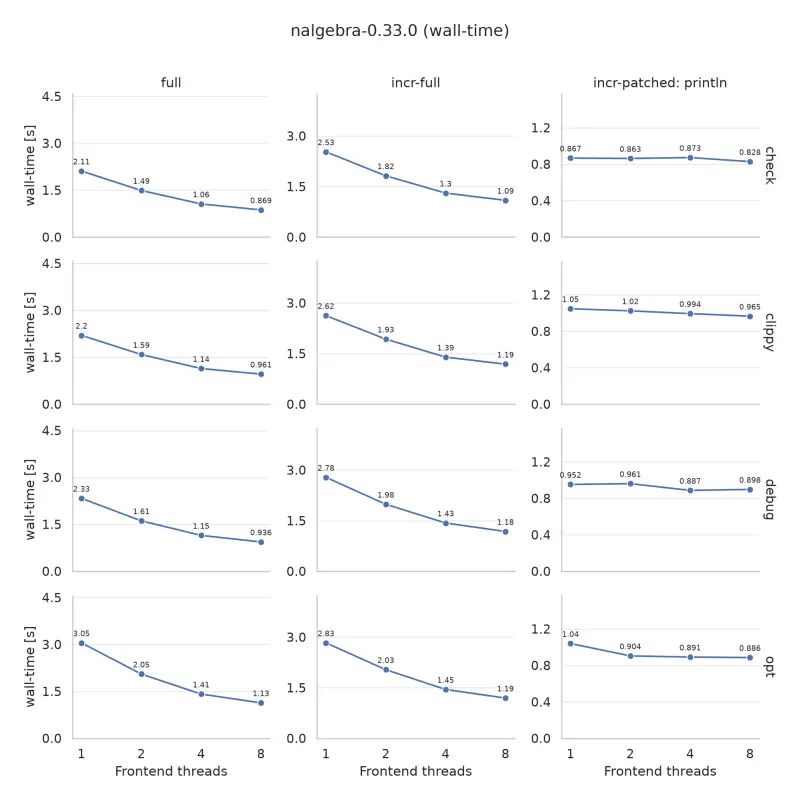
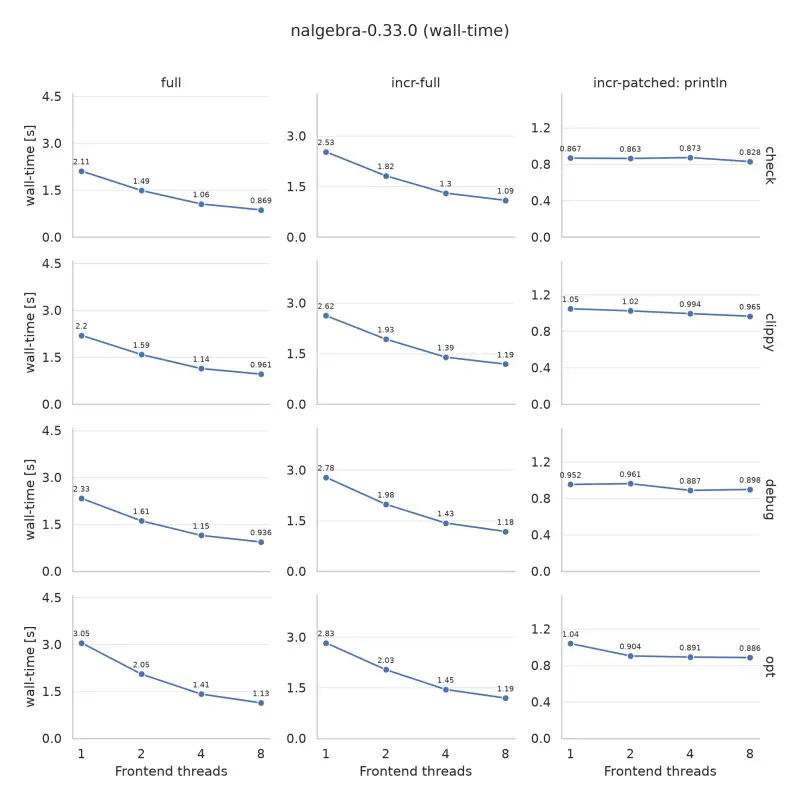
In the Rust compiler’s benchmark suite, the team measured wall time to compile a single “leaf” crate from scratch. Results varied by crate and configuration. For some cargo check runs, including tests involving nalgebra, cargo and diesel, eight frontend threads made compilation almost three times faster. Other benchmarks showed little improvement.
Across the suite’s real-world benchmarks, the average changes compared with a sequential frontend were:
| Frontend threads | check | clippy | debug | opt |
|---|---|---|---|---|
| 2 | 21.95% faster | 20.74% faster | 14.2% faster | 12.51% faster |
| 4 | 37.99% faster | 36.01% faster | 29.14% faster | 23.67% faster |
| 8 | 44.23% faster | 41.76% faster | 36.1% faster | 27.88% faster |
These figures describe a single crate built from scratch, so they shouldn’t be read as a promise about every project’s full build. At eight threads, the team saw cargo check become about twice as fast for several tested crates. Incremental rebuilds gained much less: the benchmark suite showed an average improvement of 3–5%, and the team says its measurements for that use case are limited. The result can change depending on which files changed and how code generation units are arranged.
A whole project can behave differently from a single crate. Cargo may already be compiling several crates at once, while LLVM uses threads in the backend. When those tasks have filled the available cores, adding frontend threads has less room to help. In an end-to-end cargo check of the cargo crate on an eight-core machine, the measured times were 36.7 seconds with one frontend thread, 35.1 with two, 31.9 with four and 30.8 with eight. The eight-thread result was about 15% faster than the single-thread run.
Set the thread count, or switch back
Nightly starts at two frontend threads to limit additional memory use while still gathering feedback. Developers can change the count with the unstable --jobs-frontend option, passed through RUSTFLAGS or a Cargo configuration file. For example:
[build]
rustflags = ["-Zunstable-options", "--jobs-frontend=8"]
The team expects scaling above roughly eight threads to be limited, though results will depend on the workload. Higher counts can use more memory and, in extreme cases, cause the compiler to run out of it. Stable Rust continues to use the sequential frontend by default.
Nightly users who need to disable the parallel frontend can set the thread count to one:
[build]
rustflags = ["-Zunstable-options", "--jobs-frontend=1"]
Correctness remains the test
Parallel execution can change the order in which compiler diagnostics appear. In some cases, it can also produce binaries that aren’t reproducible, which the Rust team considers a bug. Open issues track known reproducibility problems, and reports of compiler crashes or differing build outputs are especially useful during this testing period. Users can report problems through GitHub or Zulip.
The team plans to monitor reports over the coming months before deciding whether the frontend is ready for stabilization. It also expects further performance work: much of the effort so far has focused on correctness, and some frontend stages still run sequentially. Work has included parallel macro expansion and name resolution, alongside a pull request to parallelize lowering the Abstract Syntax Tree into the High-Level Intermediate Representation.
For nightly users, the practical next step is to try the two-thread default on representative builds and check both compile time and memory use. Wider stabilization will depend on whether that real-world testing turns up serious correctness or reproducibility problems—and whether the performance gains hold across complete project builds.