Why Online Content Is Harder to Verify—and the Habit That Helps
- Richard Davis
- 677 reads
AI generated posts, fast moving feeds and weaker moderation make verification harder. A deliberate pause can help people assess what they see.
Online, a convincing image or a confident account can be easy to mistake for evidence. Artificial intelligence has made fabricated material more lifelike, while social platforms reward posts that trigger quick reactions. The practical response starts with a small change in habit: pause and ask why a post appeared, who benefits from sharing it, and what evidence supports it.
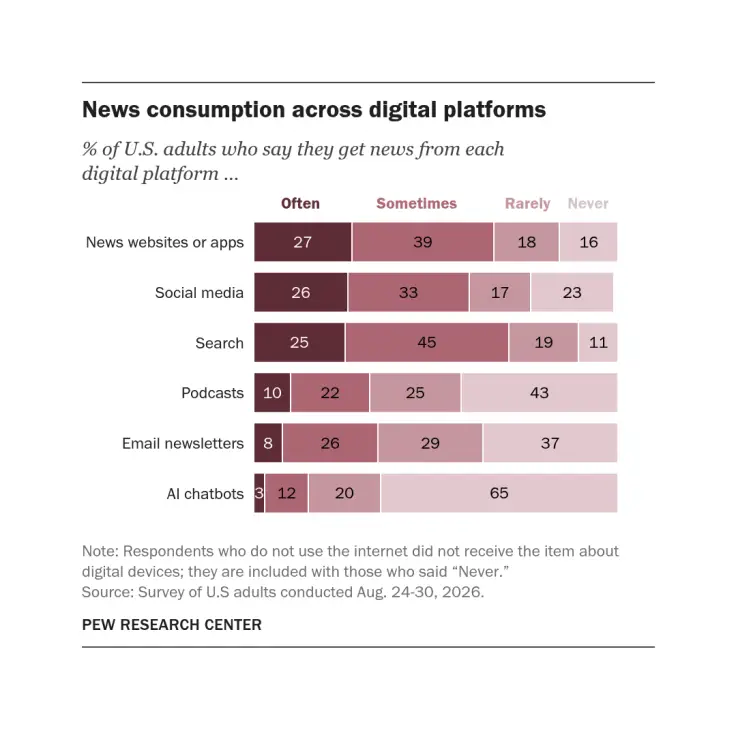
That pause matters because people use the internet for work, services, entertainment and news. More than half of Americans get news through social media, and many people rely on online platforms as part of their livelihood. Leaving the internet entirely isn’t a realistic answer for most. But moving through it on autopilot makes misleading material harder to spot.
Media literacy hasn’t kept pace
People are being asked to judge content in an environment that has changed faster than the instruction available to help them. Chuck Salter, president and CEO of the News Literacy Project, says most states don’t require school districts to teach news and media literacy. A 2024 survey by the National Association for Media Literacy Education found that just 12 percent of schools included media literacy in their core curriculum.
The gap extends beyond school. About 25 percent of U.S. adults read at the lowest literacy level, and a third of U.S. workers lack basic digital skills, according to the figures cited in the report. In a 2025 Pew Research survey, around half of respondents said they had difficulty identifying inaccurate news online.
Even experienced users face a crowded stream of posts built to attract attention. Sofia Rubinson, senior editor at misinformation watchdog NewsGuard, says social platforms contain false and misleading material, including AI fabrications, distorted claims and coordinated deception. Pew Research data cited in the report suggests more than a third of new web content is AI generated. Other estimates put the share of the internet made up of AI generated material above half, though estimates vary.
Bot counts are just as uncertain: estimates range from roughly 10 percent of accounts on some platforms to nearly half. Cloudflare CEO Matthew Prince has said automated agents account for 57.4 percent of internet traffic, compared with 42.6 percent from people. Those figures describe different things and come from different estimates; together, they point to a web where apparent crowds and consensus can be difficult to assess.
Feed design accelerates the problem
Social platforms don’t simply display information in a neutral order. Marijus Briedis, chief technology officer at NordVPN, says feeds are designed to keep people moving and tend to reward content that provokes a reaction. Infinite scroll, autoplay and personalized recommendations can shorten the time between seeing a claim and responding to it. Synthetic content is well suited to that environment: it can be produced quickly, tailored to an audience and optimized for attention.
Fast browsing also changes how people interpret popularity. Roei Sherman, senior director of research at cloud security firm Mitiga, says users may treat likes and shares as proof that many people believe a claim. In practice, those signals show that a post drew engagement. They don’t establish that it’s accurate, or that the accounts behind the engagement belong to real people.
Finding context can take extra effort, too. Some platforms make it awkward to link to outside reporting or check a claim against another source. When a post offers little context and the feed keeps moving, users are left to rely on instinct. That’s precisely when a deliberate pause is most useful.
Moderation has limits
Human review teams have been reduced at large platforms including Meta and X, while automated systems and community contributions play a larger part in handling content. Zohaib Ahmed, CEO of deepfake detection company Resemble.AI, says weaker moderation can allow misleading material to circulate more freely. He also describes an “Indistinguishability Threshold”: the point where people can no longer reliably tell authentic material from fabricated material using their senses alone.
That creates a difficult review problem. When an image, voice or video looks and sounds plausible, platforms and users need more than a quick visual check. Community labels can help, but Ahmed warns that they may be imprecise or divided. Many people will see a label and move on without checking how it was reached. Automated detection tools may assist, but the source provides no basis for treating them as a complete answer.
The same caution applies to personable chatbots and AI agents. Eyal Elazar, head of market intelligence at e-commerce security firm Riskified, says familiar, friendly interfaces can encourage people to lower their guard. Tools that gather information into a single prompt or click offer convenience, but they also make it easier to accept an answer without checking where it came from. As Salter puts it, people still need to exercise their own judgment.
Build a pause into the routine
Andrew Jones, co-founder of AI security firm Adaptive Security, says people don’t need technical training to protect themselves. The useful first step is to interrupt the reflex to react. Before resharing a startling claim, ask who posted it and why. Check whether the account has a track record, look for the original material, and compare the claim with independent sources. For an image or video, seek context beyond the caption and consider whether the post gives enough information to verify when and where it was made.
These checks won’t settle every question, and constant suspicion carries its own cost. News Literacy Project’s Salter draws a distinction between skepticism and cynicism: skepticism asks for evidence; cynicism can lead people to accept whatever confirms their views or reject material that challenges them. Briedis adds that when people assume everything can be faked, they may begin doubting genuine information as well.
New online instincts will take time to develop. Until then, a few minutes spent checking context can help counter a feed designed for speed. Stay connected to people you trust, discuss viral claims, and keep asking what supports the content in front of you. The goal isn’t to distrust every post; it’s to make sharing and believing a deliberate choice.