Silicon-Carbon Batteries Put 7,000mAh Cells in Slimmer Phones
- Kitek Sood
- 711 reads
Silicon-rich anodes are raising phone battery capacity, but battery aging, manufacturing costs and shipping constraints shape where they appear.
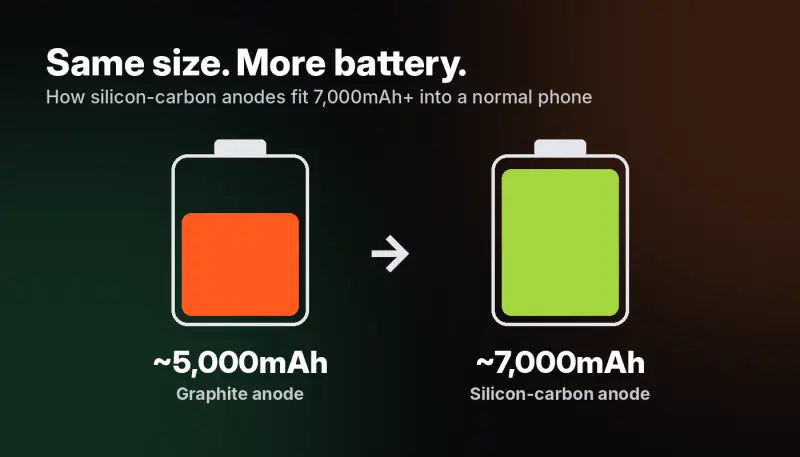
Silicon-carbon anodes have changed the battery trade-off in smartphones: manufacturers can fit more capacity into a given space, or make a phone thinner without cutting capacity as much. That shift helps explain why some recent models now reach 7,000mAh or more, while many flagship phones from Apple, Samsung and Google remain near 5,000mAh.
The change is visible in recent devices. The OnePlus 15 has a 7,300mAh battery; Tecno has put an 8,000mAh cell in a phone 7.42mm thick; and Honor sells a phone with a 10,000mAh battery in an 8.3mm body. Those figures would be difficult to achieve with graphite anodes at the same size. They don’t, by themselves, tell you how long a phone will last: the display, processor and software also affect power use.
Why silicon increases capacity
A lithium-ion battery stores and releases energy as lithium ions move between its cathode and anode. For decades, graphite has been the standard anode material. It’s affordable and stable, but its storage capacity is limited: one lithium ion for every six carbon atoms. Once manufacturers had made practical use of graphite’s capacity, adding more battery life generally meant adding more physical volume.
Silicon can hold substantially more lithium per gram. LG Energy Solution says its theoretical capacity is four to ten times that of graphite. Mixing some silicon into the anode can therefore raise the energy stored in the same space. The cathode and electrolyte remain part of a conventional lithium-ion cell; the main change is the anode, where silicon joins a carbon structure.
Pure silicon isn’t a practical shortcut. As it absorbs lithium, it expands, by as much as 300% when fully charged, according to Android Authority. Repeated expansion and contraction can damage the electrodes and put pressure on the phone’s other components. Manufacturers manage that strain in a few ways: they use a limited share of silicon, reduce it to small particles that are less prone to cracking, and surround it with a carbon matrix that leaves room for expansion.
The proportions vary. LG Energy Solution says its first silicon anode for electric vehicle batteries, introduced in 2019, used about 5% silicon. OnePlus says the Silicon NanoStack battery in the OnePlus 15 uses up to 15%. The rest of each anode remains carbon based. These designs trade some of silicon’s theoretical capacity for a cell that can better tolerate repeated charging.
More capacity, or a slimmer phone
Estimates of the capacity gain vary. Android Authority puts it at roughly 10% to 20% more in the same volume; How-To Geek cites a range of 20% to 50%. As a rough illustration, that can mean moving from a 5,500mAh cell toward 7,000mAh without making the phone thicker. The actual result depends on the cell design and how much silicon it uses.
Phone makers can spend that extra density in two ways. They can put a larger battery in a familiar-sized handset, as OnePlus has done, or keep capacity closer to conventional levels while making the phone thinner. Foldables have a strong reason to pursue the second option: their two halves must fit around a hinge, and every millimetre affects the folded device.
Some manufacturers are pushing capacity further. Honor’s 10,000mAh phone and Tecno’s 8,000mAh model show how silicon-carbon designs can support large cells in relatively slim bodies. For buyers, though, capacity is only one part of the decision. Reviews offer a better guide to real battery life than the number on the box.
The costs behind the capacity
Silicon still expands and contracts during charging, so silicon-rich cells may lose capacity faster over time. A battery engineer interviewed on the Waveform podcast said these batteries tend to lose more capacity in their first two to three years than conventional cells, according to 9to5Google. OnePlus says the OnePlus 15 battery retains 80% capacity after four years in its own simulated tests. Independent long-term evidence remains limited because most phones using these cells have been available for less than two years.
Manufacturers can also reserve some capacity to limit wear. The Nothing Phone (3), for example, has a cell with a physical capacity of 5,500mAh but is sold as a 5,150mAh phone outside India, according to 9to5Google. That gap illustrates why published capacity may not equal the energy available to the user.
Production presents another hurdle. Silicon anodes depend on complex processes involving very small particles and carefully controlled materials. How-To Geek reports that those processes currently cost more than producing graphite anodes. For companies shipping phones at enormous scale, added manufacturing expense and cell design changes both matter.
Why regional models can have different batteries
Battery size also affects shipping. Under UN Special Provision 188, a lithium-ion cell of up to 20 watt-hours can move under simplified transport rules. Above that threshold, the device needs additional handling, labels and paperwork. At a typical voltage of 3.8 volts, 20 watt-hours is about 5,300mAh.
That limit helps explain the battery sizes in some widely sold flagships. The Galaxy S25 Ultra’s 5,000mAh battery is about 19.4 watt-hours, while the Pixel 9 Pro’s 5,060mAh cell is about 19.7 watt-hours, according to 9to5Google. Both sit just below the threshold described in the rules.
There are ways to build around it. A phone can split its capacity between two cells, since the limit applies to each cell. That approach adds circuitry and cost, but some Chinese brands already use dual-cell designs. Manufacturers can also sell different capacities in different regions, where international shipping requirements differ. Android Authority reports that the Xiaomi 15 Ultra has a 6,000mAh battery in China and a 5,410mAh version globally; the HONOR Magic 7 Pro has 5,850mAh in China and 5,270mAh in Europe.
Apple, Samsung and Google serve global markets through complex supply chains, so a different cell design can affect cost and logistics as well as battery life. Samsung also has reason to move carefully after the Galaxy Note 7 battery recall in 2016. The company is rumored to be testing a dual-cell design, but broad adoption by the biggest phone makers has yet to follow.
What to check before buying
A larger silicon-carbon battery will usually offer more runtime than a smaller graphite cell, but the capacity figure isn’t a guarantee. Check independent battery reviews, the maker’s cycle-life claims and the warranty available in your region. If your phone offers an 80% or 85% charging limit, using it can reduce stress on a lithium-ion battery. When the same phone has different capacities across regions, transport requirements may explain the difference.
The next questions are practical: how these cells age over four or five years, how they handle heat during fast charging, and whether more manufacturers can bring production costs down. Silicon-carbon batteries have already made high-capacity, slim phones possible. Their long-term durability and wider availability will determine whether that advantage spreads to the largest global product lines.