Gemini 4 Carbon Adds Longer Reasoning to Google’s Gemini API
- Robert Miller
- 917 reads
Carbon builds on Argon with more reasoning tokens per turn. Its key tradeoff is longer responses and potentially higher bills for complex tasks.
Gemini 4 Carbon’s main change is how much work it does before answering. Google describes the model as spending more thinking tokens to explore a problem and check its work. That may help on tasks where a shallow answer is costly, but it also means more token use and longer waits than with its sibling Argon.
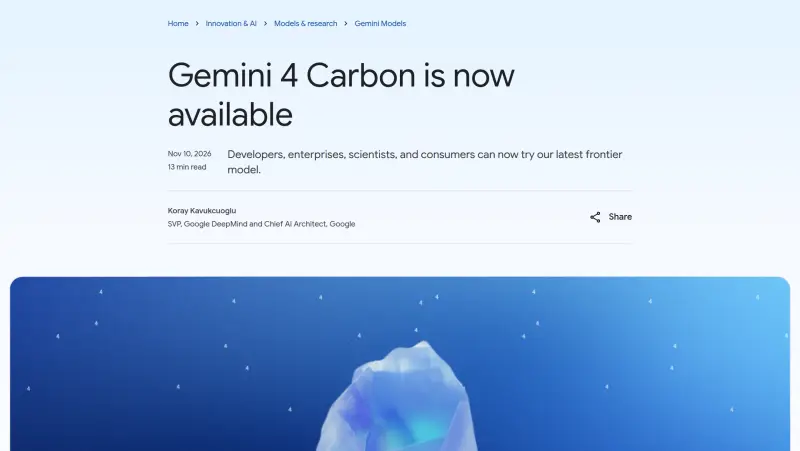
Google made Carbon generally available through the Gemini API on November 10, 2026. The two models share a context window of about one million tokens, built-in tools, and the same per-token prices. The practical distinction is that Carbon can spend more tokens reasoning through a turn. Developers choosing between them are weighing answer quality on demanding tasks against response time and total usage.
What changes when a model thinks longer
Carbon is a top-tier model in Google’s Gemini family. It accepts text, images, audio, video, and PDFs, and generates text. Its stated knowledge cutoff is March 2026. Its model card describes it as based on Argon, which became generally available in October 2026.
Thinking tokens are generated during the model’s internal reasoning, before it produces the answer presented to the user. They count toward billing at the output-token rate. That detail matters: a short visible response can still involve a larger amount of billable output if the model used many tokens to reason first. In some cases, the reasoning cost can exceed the cost of the answer itself.
That makes Carbon a different operating choice, even though its listed price per token matches Argon’s. A task that prompts Carbon to reason at length can consume more output tokens than the same task sent to Argon. The shared context limit and tools make the models easier to compare within an existing Gemini integration, but they don’t make their usage costs identical in practice.
Where the tradeoff may pay off
Carbon is most relevant when the task benefits from checking intermediate steps or comparing several possible answers before responding. For instance, a team might try it on complex analysis or code work where errors carry a real cost. The source information doesn’t provide benchmark results or quantify how much more accurate Carbon is, so those gains need to be measured against the team’s own tasks.
For routine prompts, simple extraction, or low-latency user interactions, Argon may be the more economical fit. If both models have the same listed token rates, the cost difference comes from how many tokens each turn uses; the time difference comes from Carbon spending longer on its reasoning. Teams should compare end-to-end results, including latency and token usage, rather than judging only the final response.
Carbon’s approximately one-million-token context window supports large inputs, including combinations of documents and other media. That capacity is shared with Argon, however, so it isn’t a reason by itself to switch. The decision depends on whether Carbon’s additional reasoning improves the result enough to justify its extra usage on a particular workload.
Pricing and API controls
Through November 30, 2026, Carbon costs $2 per million input tokens and $10 per million output tokens. The listed rates double after that date. Since thinking tokens are billed as output, developers evaluating the model should include them in cost estimates instead of counting only the text returned to the application.
The API call uses client.interactions.create(), and developers can set thinking_level to tune the model’s reasoning. That gives applications a way to make reasoning effort an explicit configuration choice. A useful evaluation can test the same prompts at different settings, recording answer quality, elapsed time, and total input and output tokens. The source doesn’t specify the available setting values, so teams should check the API documentation before building configuration around particular levels.
What to evaluate before switching
Carbon keeps the same broad input capabilities, tools, and context window as Argon, which should make a side-by-side API evaluation straightforward for applications already using the Gemini family. The main migration questions are operational: whether the added reasoning improves the outputs that matter, whether users can tolerate the extra wait, and how the higher token consumption affects budgets—especially after the temporary pricing period ends.
Google’s model card and product documentation are the places to track how the model’s behavior and API controls are described. For now, Carbon looks like a targeted option for work that benefits from more reasoning, rather than a default replacement for every Argon request. Teams can make that call by measuring representative tasks and comparing the value of better-checked answers with the cost and delay of producing them.


