Cloud Inventory and Anonymous Probes Make Application Exposure Easier to Verify
- Thomas Johnson
- 839 reads
Overexposed checks deployed GKE Ingresses and Cloud Run services from the outside, then records evidence behind each exposure verdict.

Knowing that a service could be reached from the internet doesn’t tell you whether an anonymous visitor can actually use it. Overexposed, a scanner built to check that distinction, combines Google Cloud’s inventory of deployed services with a small set of outside-in HTTP probes. Its central design choice is to judge what’s running and how it responds, rather than infer access from configuration files alone.
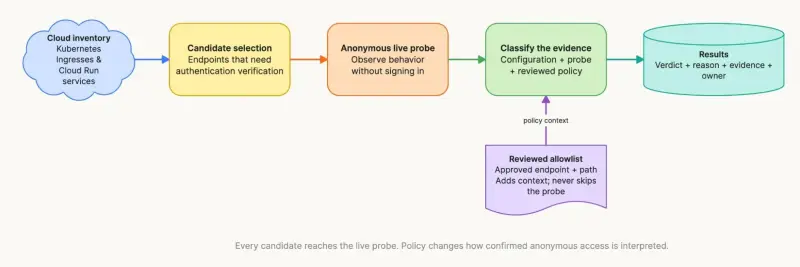
The scanner currently covers Kubernetes Ingresses on Google Kubernetes Engine (GKE) and Cloud Run services. It runs on a schedule and assigns each endpoint one of six outcomes: exposed, expected, protected, not found, unreachable or inconclusive. Each outcome includes evidence about the deployed configuration, the probe response, any access control encountered and, when available, the team responsible.

Inventory the deployed services
The first version searched Kubernetes files in an infrastructure repository for public hostnames without an authentication setting, then tried a live request. That approach confused intended configuration with effective access. Some teams set proxy authentication through Ingress annotations the scanner didn’t recognize, creating false alarms. In other clusters, an admission controller changed an Ingress as it was accepted, so repository settings didn’t describe the deployed result. And services managed through other repositories or platform tools never appeared in the scan.
Ingress configuration remains useful context, but it cannot establish what a cluster is enforcing. Overexposed switched to Google Cloud’s Cloud Asset Inventory, which records resources in an organization, including GKE Ingresses after admission controllers have run, Cloud Run services and load balancers.
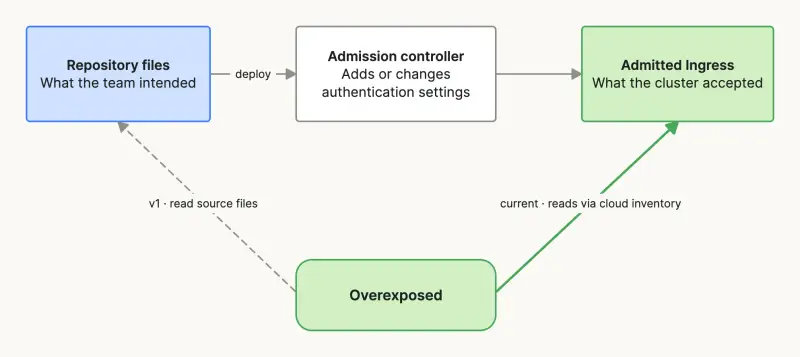
The repository describes intended configuration; the cluster inventory reflects what was accepted.
The scanner searches the inventory for the resource types it covers, then performs a second search for access policies. The team says this works without cluster credentials. That change also surfaced Cloud Run services across projects that the repository-based scanner had missed, expanding the set of services under review.
Probe as an anonymous visitor
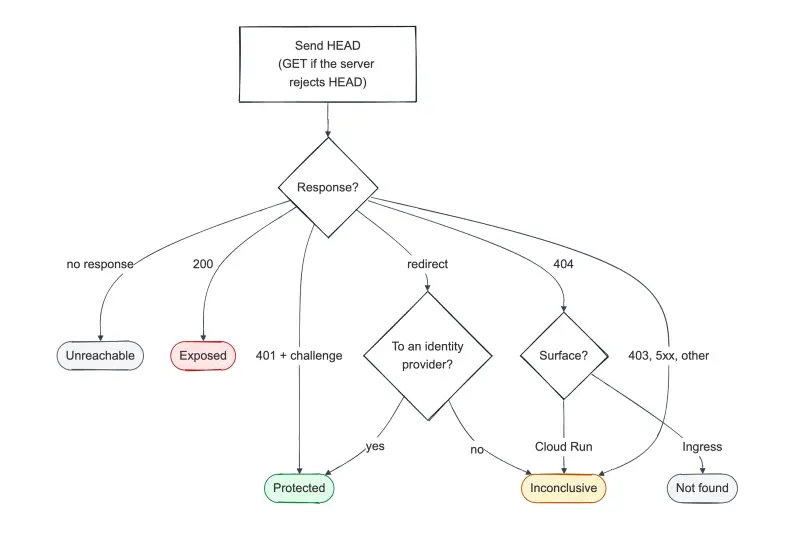
An inventory identifies candidate public surfaces; an external request helps establish whether one actually responds to someone without a login. Overexposed sends an anonymous HTTP request to each candidate. It tries HEAD first and falls back to GET if a server rejects HEAD. It doesn’t automatically follow redirects: it checks up to three, examining each destination. A redirect to an identity provider or a 401 response with an authentication challenge counts as protected. A 200 response with real content counts as exposed.
Those rules need care around paths. An application might protect /admin but handle /ADMIN differently if its routing is case-sensitive. The scanner checks variations so a single protected path doesn’t stand in for every route on the host.
Cloud Run requires a separate look at network reachability and identity. Its ingress setting controls which networks can reach the service; Identity and Access Management (IAM) controls who can invoke it. A service that accepts traffic from all networks can still reject anonymous callers if the allUsers principal lacks the invoker role and the invoker check remains enabled. In that case, a stranger may get a 403 even though the network path is open.
A load balancer adds another point where access can be controlled. A Cloud Run service behind one may allow anonymous requests while the load balancer or application requires authentication. Identity-Aware Proxy is one possible control. To understand which service handles a path, Overexposed reads the load balancer’s URL map.

Authentication can be enforced at different points between a request and a Cloud Run service.
Make uncertainty visible
An HTTP status code doesn’t always settle the question. Overexposed classifies responses according to both the service type and the evidence gathered. For an Ingress, a 404 means the proxy responded but the requested path wasn’t found. For Cloud Run, Google’s front end can return a 404 before the application runs, so the result doesn’t establish whether authentication would have succeeded. A 403 also isn’t proof of protection: an application can deny a request for other reasons.
The scanner treats a 401 with an authentication challenge as protected. A response that doesn’t support a clear judgment stays inconclusive. A failed connection is unreachable; a responding service with a missing endpoint is not found where the evidence supports that call. This distinction prevents the scanner from turning every denial or error into a reassuring result.
Public access can be intentional, so the team maintains a reviewed allowlist matched to an exact host and path. It doesn’t bypass probing. If an endpoint is open and matches an approved entry, the result is expected rather than exposed. If a listed endpoint becomes protected or disappears, the scanner records that change and flags the entry for review. The allowlist therefore supplies context while the recurring check still detects drift.
The six verdicts give teams a useful range: exposed means anonymous access worked without an approved match; expected means it worked for an approved endpoint; protected means an access control blocked the request; not found means the endpoint is absent; unreachable means the scanner couldn’t connect; and inconclusive means the evidence doesn’t support a firm call.
Keep the probe from becoming a risk
A service that makes requests to endpoints can be abused to reach internal systems, a risk known as server-side request forgery. A hostname that looks ordinary may resolve to a private or loopback address. Overexposed checks hostnames and every IP address returned by DNS, rejecting known internal names and disallowed addresses.
It then connects directly to a checked IP address rather than resolving the hostname again. That avoids a second lookup changing the destination, while the original hostname remains in use for the HTTP request and HTTPS certificate checks. The scanner repeats its destination checks before each redirect. The team also recommends restricting the scanner’s network access so it cannot reach internal services or cloud metadata endpoints.
Improve verdicts with recorded evidence
Every result stores what was configured, what the anonymous probe observed, whether an allowlist entry matched and, when available, the owning team. The scanner doesn’t retain response bodies or credentials; the team says those aren’t needed to explain a verdict and could contain sensitive information. Keeping the evidence behind the outcome gives engineers a basis for investigation and comparison across scheduled scans.
Early runs produced many inconclusive results: about three in four in one July run. The team grouped them by reason and made rules more specific where the evidence allowed, including clearer not found and unreachable outcomes. When evidence remained ambiguous, the scanner continued to report inconclusive.
Before changing a rule, the team replays it against saved scan results and compares the verdicts. Over a few weeks, this reduced inconclusive Ingress results by about 80%, according to the team. That figure describes one part of this scanner’s results; the account gives no comparable reduction for Cloud Run.
Test the checks as well as the code
AI coding agents helped build Overexposed, and AI code review checked each change. The team found that passing tests alone didn’t guarantee a test checked the intended behavior. One test verified that a SQL parameter existed but didn’t verify that the query used it.
To catch that gap, the team uses mutation testing on safeguards: remove the code meant to enforce a rule and see whether the tests fail. If they still pass, the tests haven’t demonstrated that the safeguard works. The pipeline also runs a canary for each verdict, with a known expected result, to catch changes that misclassify a familiar case.
Overexposed’s main practical lesson is that exposure checks need a current inventory, an outside-in probe and verdicts that preserve uncertainty. Its current scope is GKE Ingresses and Cloud Run, so teams using other service types would need to extend the inventory and classification rules. For the covered services, the next useful signal will be whether repeated scans keep producing evidence teams can act on as routes, access controls and deployed resources change.


