Vendor Breach Leaks Marketing Data Linked to Visa, Mastercard and JPMorgan Chase Customers
- Robert Johnson
- 944 reads
A ransomware group's leak of vendor-held marketing data tied to Visa, Mastercard and JPMorgan Chase customers shows why contact details still matter.
The headline names three banks, but the more useful story is the supply chain behind them. JPMorgan Chase, Visa and Mastercard all say their payment systems weren't the entry point. Each points instead to a third-party vendor that held customer marketing data, and that vendor is where the trouble started.
On November 19, the companies acknowledged incidents involving outside providers. The ransomware group n0n has claimed responsibility and published files it says it stole. Those files haven't been independently verified, so treat the figures below as researchers' reading of unconfirmed material, not established fact.
Where the exposure sits
For engineers, the architecture point is the important one. Payment processing and marketing tooling are usually separate systems, but the marketing side tends to collect far more personal data and spread it across more hands. Vendors running campaign platforms, loyalty programs or card-benefit portals often receive names, email addresses, phone numbers and activity records. That data rarely needs to be as tightly controlled as card numbers, and that's exactly why it ends up as the softer target.
JPMorgan's description is the most specific of the three. In a statement to Reuters, the bank said: "Based on our investigation so far, we believe the attackers accessed certain marketing data held by those vendors, which may include some customer names and email addresses." Its position is that no payment data was involved, but it doesn't read that as a reason to dismiss the exposure.
Visa said it is aware of the claims and that they relate to an incident at a third-party service provider in the Asia-Pacific region. Mastercard said an incident at a third-party provider exposed a limited number of email addresses tied to one card-benefit program, and it classed that as non-payment information.
Cybernews researchers reported that formatting similarities across the leaked files suggest a single common provider. That provider hasn't been named. Its role may involve dining, reservations or loyalty programs rather than payment processing, and the leaked records appear to come from those extra services. If that reading holds, the three brands aren't three separate failures. They're three clients of one weak link.
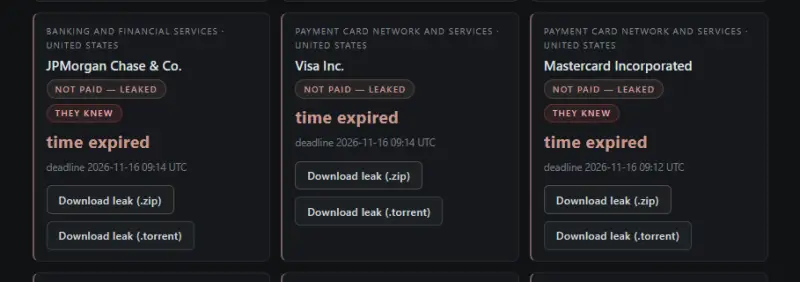
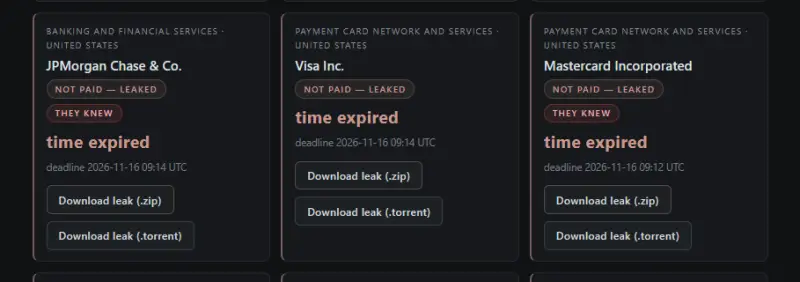
The n0n leak site lists JPMorgan Chase, Visa and Mastercard. The group claims it published the data after a ransom deadline of November 16 passed without payment.
What the leaked files appear to contain
Here's the thing about the numbers: the companies' disclosures are narrow, while the researchers' analysis is broader. Cybernews described the following fields, none of which has been confirmed by the companies.
- JPMorgan Chase: Roughly 16,000 customer email addresses, some phone numbers, identifiers described as account IDs, and more than 100 employee email addresses.
- Visa: A dataset covering more than 6,000 premium customers, with names, email addresses, phone numbers, messaging-app information, and booking details such as dates and addresses.
- Mastercard: Marketing information for customers in North America, the Middle East and Africa, plus a small number of Mastercard employee email addresses, according to reporting by Reuters.
The Visa entry deserves the closest attention. Booking details and messaging-app information go well beyond what a marketing list normally needs. Even without card numbers, that combination describes who someone is, how they like to be contacted and when they're travelling or dining out.
Why the absence of card numbers isn't the whole story
Financial fraud has long been built on context, not just on account numbers. A message that opens with your real name, the bank you use, the card program you enrolled in and a recent reservation looks far more legitimate than a generic phishing email. Account identifiers, if they're genuine, add another layer, because they make it easier to imitate the institution's own correspondence.
That's why "no payment data" is accurate but incomplete. It limits the immediate risk of direct card misuse. It doesn't limit the risk of a convincing scam that uses a customer's details to ask for something that does matter, like a login code or a transfer.
For product and platform teams, the lesson is less about these three brands and more about how marketing data flows. Scoping vendor access to the minimum fields a campaign needs, separating loyalty or benefit data from identity data, and auditing which subprocessors touch personal records are the controls that would have reduced the blast radius here. Those steps are unglamorous, and they're usually the first things to slip when a marketing team needs a new integration quickly.
What affected customers should do
If you think your information may be involved, the practical steps are straightforward, even if they're tedious:
- Verify messages independently. Open your bank's app, type in a website address you already know, or call the number printed on your card or statement. Don't use a link or phone number supplied by someone claiming to be investigating the breach.
- Never read out a login or verification code to an unexpected caller. Codes are often the final piece a criminal needs. Enter them only when you've started the action yourself in the genuine service.
- Don't move money to "protect" it. A caller urging you to shift savings into a safe account is attempting theft. Hang up and contact your bank through a channel you trust.
- Check breach support before enrolling. JPMorgan says it will contact affected customers where appropriate and offer support, including complimentary credit monitoring. Confirm any offer through the bank itself before you sign up.
- Consider a credit freeze as a separate identity-protection step that doesn't depend on any one company's response.
What to watch next: whether the common provider is named, whether the companies notify more customers as their reviews progress, and whether n0n publishes further material. Any of those developments would change the scale of the exposure. Until then, the working assumption should be that any unsolicited message citing these brands could be informed by real data.