Crypto Payment Gateways: Custody, Wallet Control and Self-Hosting Compared
- idempotent-dev
- 387 reads
Crypto checkout choices determine who controls funds and who handles wallet operations, network fees, infrastructure and payments to old addresses.
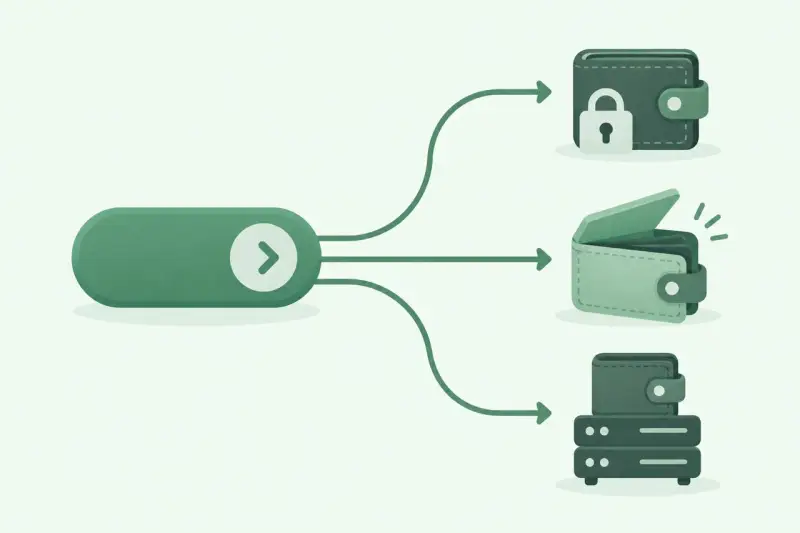
The key decision in a crypto checkout is what happens after payment: who controls the funds, and who has to keep them moving? A gateway can hold the money, track payments sent directly to a merchant’s wallet, or be replaced by infrastructure the merchant runs. Each model shifts work and risk between the provider and the business.
That distinction can be easy to miss when comparing supported coins, fees or setup time. It becomes concrete when a withdrawal is delayed, a wallet fills with small deposits, or a customer pays to an address the store stopped monitoring. The checkout button may look much the same in each case; the operating model behind it does not.
When the provider holds the funds
With a custodial gateway, a customer pays to an address controlled by the provider. The merchant sees a balance in the gateway’s dashboard and requests a withdrawal under the provider’s terms. The service matches incoming payments to orders and reports their status to the store.
That arrangement removes several tasks from the merchant’s plate. The team doesn’t need to manage private keys, watch blockchain activity, or work out how to move each received token. For a small business with limited engineering time, that convenience can be a meaningful reason to choose custody.
The tradeoff is control. A dashboard balance represents funds held by another company, rather than assets in a wallet the merchant can access directly. Withdrawals may have minimums, fees or limits. An unusual amount could prompt manual review, while an account restriction, service outage or shutdown could delay access.
That dependency will feel familiar to businesses that accept card payments: a processor can hold a balance during a dispute or risk review. Crypto payments don’t automatically remove the intermediary. In a custodial setup, the dependency sits with the crypto gateway instead. Providers commonly charge a percentage of each transaction, sometimes with withdrawal or network fees on top.
When the merchant keeps the keys
A non-custodial gateway detects payments and updates orders while sending funds to wallets controlled by the merchant. One common approach uses an extended public key, or xpub, to derive a new receiving address for each order. The gateway can monitor those addresses without having the private key needed to spend their funds.
This changes what happens if the gateway becomes unavailable. Payment tracking and order notifications may stop, but funds already received remain accessible through the merchant’s wallet. The provider can’t restrict a withdrawal through custody because it doesn’t hold the balance.
Key ownership doesn’t make every asset immune to restrictions. Stablecoin issuers such as Tether can restrict tokens at an address level. That’s a separate risk from gateway custody, and merchants accepting stablecoins should account for it.
There’s operational work too. Sharing an xpub doesn’t expose private keys, but it can let the provider observe addresses and transactions derived from it. That activity may reveal a detailed picture of the wallet account’s incoming payments.
Unique addresses can also leave funds spread across many locations. Bitcoin payments may accumulate as small unspent outputs. On account-based networks, tokens can sit across hundreds of addresses. Moving funds may then involve extra steps and fees: ERC-20 transfers on Ethereum require ETH for network costs, while TRC-20 transfers on TRON need network resources, which can involve TRX or Energy. Depending on the wallet setup, consolidating tokens may require funding individual addresses before they can send.
Non-custodial pricing varies. Providers may charge per payment, by subscription or through fixed fees. Paymento’s WooCommerce plugin, for example, describes an xpub-based non-custodial model and a 0.5% transaction fee. The fee model doesn’t remove the need to plan for wallet management and consolidation.
When the merchant runs the payment system
Self-hosting puts the payment infrastructure under the business’s control. BTCPay Server is one example: a merchant can run its own server and blockchain node, connect a wallet, and process payments without a traditional gateway’s transaction commission.
For on-chain Bitcoin payments, the private keys can stay outside the payment server, including in a hardware wallet. Running the checkout software therefore doesn’t require placing the keys that control funds on a public-facing machine.
The operational burden shifts to the merchant. Someone must keep the server running, install updates, maintain backups, check synchronization and catch failures. The team also needs procedures for expired invoices, partial payments, refunds and tokens sent on the wrong network. Software can support those cases; it can’t decide how the business should resolve them.
Self-hosting still costs money and time. Hosting, network fees and staff effort remain, even without a gateway commission. For a company whose engineers already maintain infrastructure, those tasks may fit existing skills. A small shop without a developer may find that payment operations become a substantial extra responsibility.
How the operating models compare
| Consideration | Provider holds funds | Provider tracks; merchant holds keys | Merchant runs the system |
|---|---|---|---|
| Who controls funds? | The provider | The merchant | The merchant |
| Can gateway custody block access? | Yes, through custody and withdrawal controls | No; funds go to the merchant’s wallet | There is no third-party gateway |
| Can stablecoins be restricted? | Potentially | Potentially, by the token issuer | Potentially, by the token issuer |
| If the service goes down | Withdrawals may be unavailable | Tracking may stop, while received funds remain accessible | Availability depends on the merchant’s infrastructure |
| Setup and ongoing work | Low setup; usually little ongoing work | Low to medium setup; wallet management and consolidation | Medium to high setup; infrastructure and payment operations |
| Typical costs | Transaction percentages and possible withdrawal fees | Transaction fees, subscriptions or fixed pricing | Hosting, network fees and staff time |
| Payment history visibility | The provider sees payment activity | The provider sees addresses it tracks | No external gateway, but on-chain data is public |
There’s no single best fit. A business taking a handful of payments each month has different needs from a platform processing thousands daily. The practical question is whether the team can handle the work that its chosen model leaves with it.
Old addresses remain active
Payment addresses can outlast the invoice or checkout flow that created them. A customer might save an address in an accounting system or reuse one months later, unaware that the merchant has stopped using it. Marking an address as retired in a database doesn’t stop it receiving funds on-chain.
CoinDCX described the consequences in an October 2026 update. The Indian crypto exchange confirmed a loss of 15.99 million USDT connected to wallet infrastructure it had deprecated after a security incident in July 2025. According to the company, some customers continued depositing to old addresses. An automated service intended to move those deposits into secure wallets stopped working for a period, allowing funds to accumulate. CoinDCX said it absorbed the amount and that customer balances were unaffected.
There are unresolved questions about the timeline. On-chain investigator ZachXBT reported that one old deposit address was still being used and swept in April and May 2026, raising questions about how completely the old infrastructure had been retired.
An exchange and an online store operate at different scales, but the underlying issue applies to any business that creates addresses and later stops watching them. An address remains capable of receiving funds. The business needs to know who will detect a late payment, who controls the relevant keys, and whether the process that moves the funds is still running.
Questions to settle before connecting a gateway
Start by finding out whose wallet receives a customer’s payment. If the provider holds the funds, ask what can delay or restrict withdrawals, who makes that decision, and what access looks like during an outage. If payments go directly to merchant-controlled wallets, ask how the service handles address generation, monitoring and payment records.
Then examine the work after checkout. Who pays network fees and consolidates funds from many addresses? What happens when a customer pays late or sends money to an old address? Can the team export transaction records, order references and reconciliation data if it changes providers?
Ask what a percentage fee covers, too. A $50,000 invoice doesn’t require the blockchain to do a thousand times more work than a $50 invoice, though a provider may have other support or risk costs. A pricing page may not answer every operational question, so documentation and direct questions to the provider matter.
Crypto checkout has become straightforward to add, but custody remains a central design choice. A custodial gateway trades direct control for less wallet work. A non-custodial service keeps funds with the merchant while leaving payment tracking and wallet operations to coordinate. Self-hosting grants the merchant more control over the system and more responsibility when it fails. Whichever route a business takes, it should assign clear ownership for old addresses, fees, records and recovery before the first payment arrives.